
You topped off your pool last Tuesday. By Friday, the water was down again. You added more. It dropped again.
At what point does “probably just evaporation” stop being a reasonable answer?
That’s a question pool owners in South Florida wrestle with more than almost anywhere else in the country — and for good reason. We use our pools year-round, our summers are relentlessly hot, and a few inches of water loss can happen for completely innocent reasons. But it can also mean you have a leak quietly draining your pool, your wallet, and eventually your yard’s stability.
Before you call anyone — before you even worry — there’s one simple test every pool owner should know how to run. It takes about 24 hours, costs nothing, and gives you a clear answer.
How Much Water Should a Pool Actually Lose Per Day?
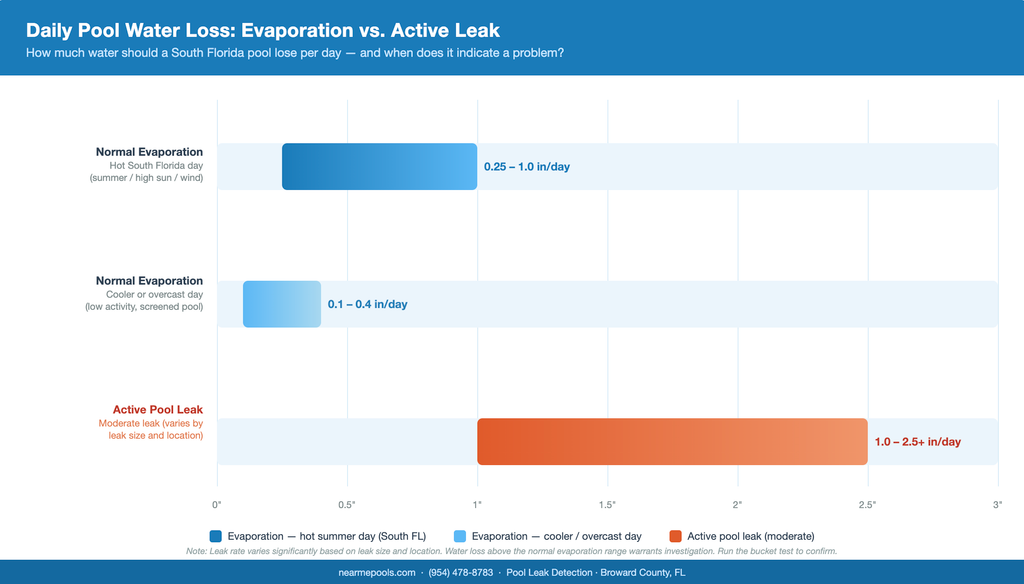
This is almost always the first question, and it’s the right one to start with. The answer: a normal pool can lose anywhere from ¼ inch to 1 inch of water per day through evaporation alone, depending on conditions.
In South Florida, that number sits toward the higher end of the range. Year-round heat, low humidity relative to surface temperature, afternoon winds, and constant direct sunlight all accelerate evaporation from an open water surface. A pool with a waterfall feature or a spa running will lose even more, since moving water evaporates faster.
A few other completely normal contributors to water loss:
- Splash-out — Particularly during heavy use, kids playing, or spa jets running, splash accounts for more than most people expect
- Backwashing the filter — A standard backwash cycle uses 200–300 gallons each time
- Evaporation during heating — If you run a heater, warm water evaporates noticeably faster
So if your pool is losing around ½ to 1 inch per day and there’s been a lot of sun, heat, and pool use — that’s very possibly just normal. It feels like a lot, but it’s within a normal range.
Where it stops feeling normal: when you’re losing more than an inch per day consistently, when the water level keeps dropping even after several cool or rainy days, or when you notice it dropping faster at certain water levels than others.
Why South Florida Pools Evaporate Faster Than You’d Expect
If you’ve owned a pool in a cooler climate before, or if you’re comparing notes with a family member up north, South Florida’s evaporation rates may genuinely surprise you.
Here’s what’s driving it:
- Heat and sun intensity. South Florida averages more than 3,000 hours of sunshine per year, and summer heat regularly pushes pool water temperatures into the mid-to-high 80s. The warmer the water, the faster it evaporates — full stop.
- Wind. Coastal and inland breezes, common throughout Broward and Palm Beach counties, accelerate surface evaporation significantly. An open-air pool on a breezy afternoon can lose noticeably more water than a screened pool under similar conditions.
- Nighttime temperature drops. When the air cools faster than the pool water — common on Florida spring and fall nights — that temperature differential creates a vapor effect. You’ve probably seen the mist that forms on the pool surface on cooler mornings. That’s evaporation happening right in front of you.
- Year-round use. A pool that runs its pump and equipment continuously, twelve months a year, simply has more evaporation exposure time than a pool that sits idle half the year.
None of this is a problem — it’s just the reality of pool ownership here. A pool cover (when not in use) can meaningfully reduce evaporation loss if the numbers bother you. But first, you need to know whether you’re dealing with evaporation or something else.
How the Bucket Test Works
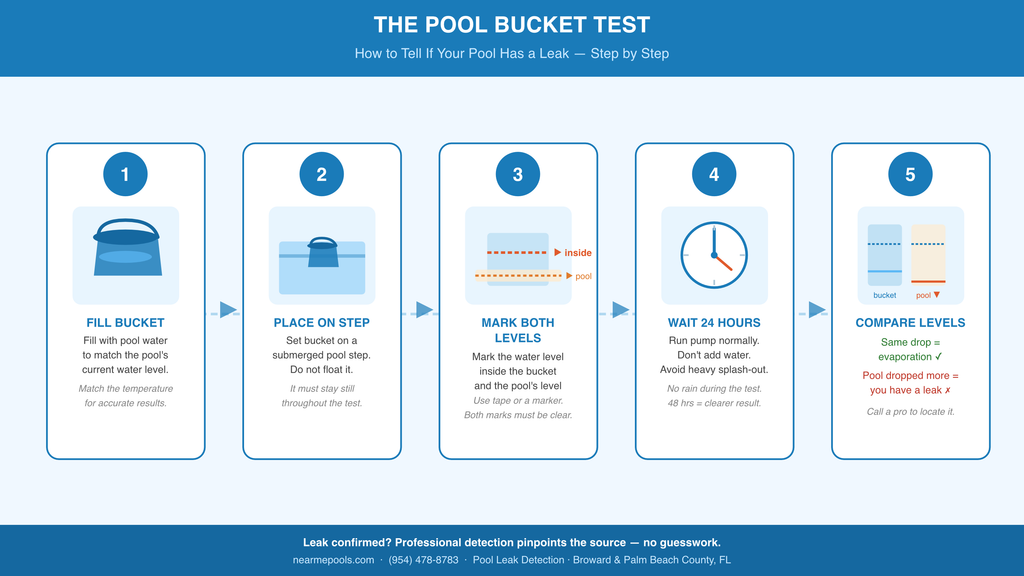
The bucket test is the standard method for distinguishing between pool evaporation and an actual leak. It’s low-tech, reliable, and something any homeowner can do. Here’s exactly how to run it.
What You’ll Need
- A 5-gallon plastic bucket (or any bucket with straight sides)
- A marker or piece of tape
- 24 hours without heavy rain (ideally 48 hours for a clearer reading)
- A pool that’s running normally — pump on, same as usual
How to Do It, Step by Step
Step 1: Fill the bucket. Fill the bucket with pool water until it’s roughly the same water level as the pool — about an inch from the top. This is important: you want the bucket water temperature to match the pool water temperature so evaporation conditions are roughly equal.
Step 2: Place the bucket on a pool step. Set it on one of the submerged pool steps, ideally at a depth where the water inside the bucket is level with the pool surface. Don’t float it — it needs to stay still.
Step 3: Mark both water levels. Use tape or a waterproof marker to mark the water level inside the bucket. Then separately mark the pool’s water level on the bucket’s exterior, on the pool tile, or with a piece of tape on the pool wall. You want clear reference points for both.
Step 4: Leave it alone for 24 hours. Keep the pool running normally. Don’t add water. Don’t backwash. Try to avoid heavy use during the test period, since significant splash-out can skew the results.
Step 5: Compare the two levels. After 24 hours, measure how much each water level dropped. If the pool dropped the same amount as the water inside the bucket — you’re looking at evaporation. If the pool dropped more than the bucket, water is leaving your pool through something other than evaporation.
How to Read Your Results
Bucket and pool dropped the same amount: You’re losing water to evaporation. The amount is within the normal range. No leak detected. Keep an eye on it over time, but you don’t have cause for alarm right now.
The pool dropped more than the bucket: This is a meaningful result. Your pool is losing water beyond what evaporation alone accounts for. That’s the definition of a leak. How much more matters — an extra ½ inch per day versus an extra 2 inches per day tells you something about the severity — but either way, you’ve confirmed something is happening.
The pool dropped less than the bucket: This almost never happens unless rain fell during the test (which would raise the pool level while the bucket surface sheds it) or there was a significant splash-in. If this is your result, redo the test on a clear, calm day.
What the Bucket Test Can and Can’t Tell You
The bucket test answers one specific question: is my pool losing more water than evaporation accounts for?
That’s actually the most important question — and it’s the one that determines whether you need to take action. A positive result confirms a real leak is present. A negative result saves you from chasing a problem that doesn’t exist.
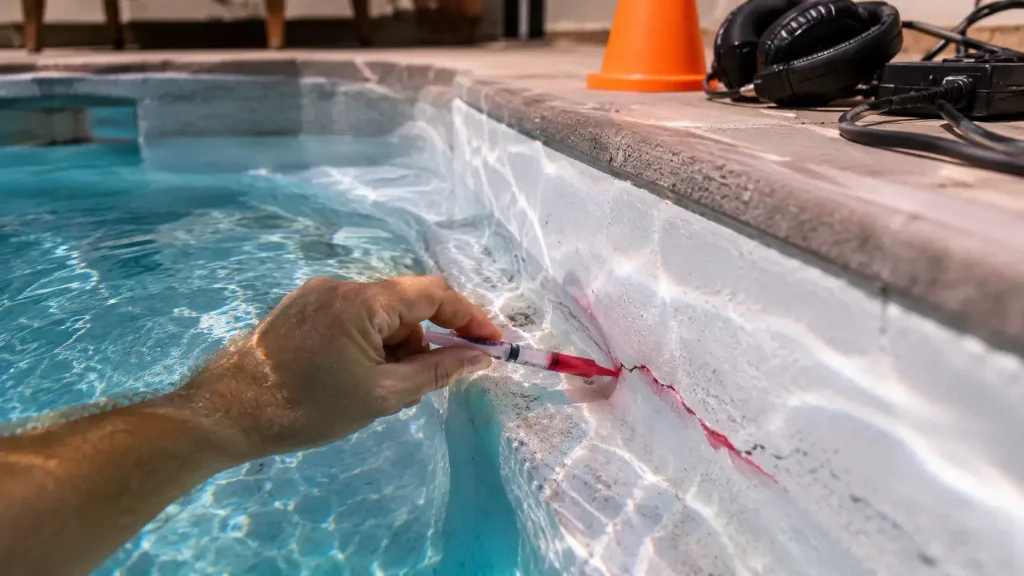
What the bucket test can’t tell you: where the leak is, how serious it is, or what’s causing it. Locating the actual source of a pool leak is a separate job — one that requires visual inspection, dye testing, pressure testing, and sometimes electronic detection equipment. That’s the part that genuinely requires professional tools and training.
If the idea of getting a professional involved concerns you about cost or complexity, understand that professional pool leak detection is specifically designed to be methodical and efficient — not a guessing game. The point is to pinpoint the leak accurately so that only the right repair gets done, rather than digging up your yard or replacing components that aren’t the actual problem.
Other Signs That Point to a Real Leak
The bucket test is the definitive method, but while you’re waiting for results — or if you haven’t run one yet — there are other signals that often point toward a real leak rather than just evaporation:
Wet spots in your yard near the pool or equipment pad. Water has to go somewhere. If you consistently notice damp soil, puddles, or unusually lush grass patches near the pool perimeter or the equipment pad, that water is coming from somewhere.
The water level stabilizes at a specific height. This is a useful clue. If your pool always seems to drop to the same level and then stop losing water, that often means the leak is at that elevation — at a fitting, a light niche, a skimmer opening, or a return jet at that waterline.
Unusually high water bills. If your water bill jumped without any other obvious explanation and you’ve been topping off the pool more than usual, the two things are almost certainly connected.
Visible cracks or separations in the pool shell. Especially around fittings, the skimmer, or in the floor or walls of the pool. Not every crack leaks — but visible damage is worth investigating.
Your chemical balance keeps getting thrown off. When you’re constantly adding fresh water to replace what’s lost, you’re continuously diluting your pool chemistry. If you find yourself rebalancing chemicals more often than usual without any clear reason, water loss may be the culprit.
What Happens After You Confirm a Leak
If your bucket test comes back positive — the pool dropped more than the bucket — you’ve answered the most important question. Now the next step is finding where the leak is coming from, which is a different challenge entirely.
The most common leak points in South Florida pools include the skimmer bond, return jet fittings, pool light niches, underground plumbing lines, and cracks in the pool shell. Each of those requires a different detection method, and some — particularly underground pipe leaks — aren’t visible at all from the surface.
That’s where professional leak detection makes a real difference. Rather than guessing or digging up your yard hoping to find the problem, a trained technician works systematically — visual inspection first, then dye testing at suspected points, then pressure testing of plumbing lines if needed. Most leaks can be located accurately within a few hours of focused work.
If your bucket test confirmed a leak and you’d rather not play the guessing game, the team at Near Me Pools handles pool leak detection across Broward County and parts of Palm Beach County.
Summary
Evaporation is normal, especially in South Florida. Losing ¼ to 1 inch of water per day to evaporation is well within range and not a cause for concern on its own. The bucket test is the right tool for separating normal evaporation from a real leak — it’s simple, free, and reliable. If your pool drops more water than the bucket over a 24-hour period, you have a leak, and it’s worth having a professional locate the source before the damage compounds. Leaks don’t fix themselves, but they also don’t have to become major projects if you catch them while they’re still manageable.
Ready to Know for Sure?
If your bucket test came back positive — or if you’ve been topping off your pool more than feels normal and want a straight answer — reach out to our team, give us a call at (954) 478-8783, or email us at contact@nearmepools.com. We’re happy to take a look and tell you exactly what’s going on.
Frequently Asked Questions
How much water does a pool lose per day in Florida?
In South Florida, it’s normal for a pool to lose between ¼ inch and 1 inch of water per day through evaporation, depending on heat, wind, sun exposure, and whether a heater or waterfall is running. If you’re consistently losing more than that — especially on cooler or overcast days — it’s worth running a bucket test.
Can I run the bucket test with my pool pump off?
Ideally, run the test with your pump operating normally. Turning the pump off changes the hydraulic conditions in your plumbing, which can actually affect whether certain leaks are active. Test under normal operating conditions for the most accurate result.
My bucket test says I have a leak. How urgent is it?
Leaks don’t tend to resolve on their own, and most get worse over time as the affected materials continue to degrade. While it’s rarely a same-day emergency, it’s worth scheduling a pool leak detection inspection promptly — especially in South Florida, where saturated soil and ground movement can accelerate the damage a leak causes.
What if it rained during my bucket test?
Rain during the test invalidates the results. Rainfall adds water to the pool but not (proportionally) to a covered or screened bucket. Wait for a 24-to-48-hour dry window and redo the test.
Can evaporation really account for an inch of water loss per day in Florida?
It can — though 1 inch is at the high end of the normal range. Factors that push evaporation toward that number include direct sun all day with no screen enclosure, warm water temperature (85°F+), afternoon wind, running a heater, and low overnight humidity. If those conditions are present and your pool is losing right around an inch, evaporation may well account for it. If you’re losing significantly more, run the bucket test.
Is there anything I can do to reduce evaporation?
A pool cover is the single most effective way to cut evaporation — it can reduce evaporation by up to 95% when the pool isn’t in use. For South Florida homeowners with screened enclosures, the screen already provides partial protection against wind-driven evaporation. Reducing heater use or scheduling it for off-peak hours can also help.