


Your pool filter is one of those things that works invisibly in the background — until it doesn’t. And when it’s time to replace yours, or when you’re setting up a new pool system, you’ll quickly discover that “pool filter” doesn’t mean one thing. It means three very different things: sand, cartridge, and diatomaceous earth (DE).
Each one cleans your water differently, requires different upkeep, and suits different pools and lifestyles. In South Florida especially — where your pool runs year-round, algae finds a foothold faster, and hard water leaves mineral deposits — the choice of filter type actually matters more than most homeowners realize.
Here’s a plain-English breakdown of all three, so you can make an informed decision.
How Pool Filters Work (The 30-Second Version)
Every pool filter does the same basic job: it traps particles as water passes through it, returning cleaner water to the pool. The difference is what it uses to do the trapping.
- Sand filters push water through a bed of pool-grade sand (or a sand alternative like glass media). Particles get caught between the grains.
- Cartridge filters push water through a pleated polyester element — similar in principle to a large air filter in your car. Particles stick to the surface.
- DE filters coat a series of grids with diatomaceous earth, a fine white powder made from fossilized algae. Water passes through the powder, which captures microscopic particles.
Each method has trade-offs in filtration quality, maintenance frequency, water usage, and cost. Let’s get into it.
Sand Filters: The Familiar Workhorse
Sand filters are the most widely installed pool filter type in the U.S., and you’ll find them on many older and mid-range pool systems across Broward and Palm Beach County. They’re durable, simple, and low-drama — which explains why they became the default.
How They’re Maintained
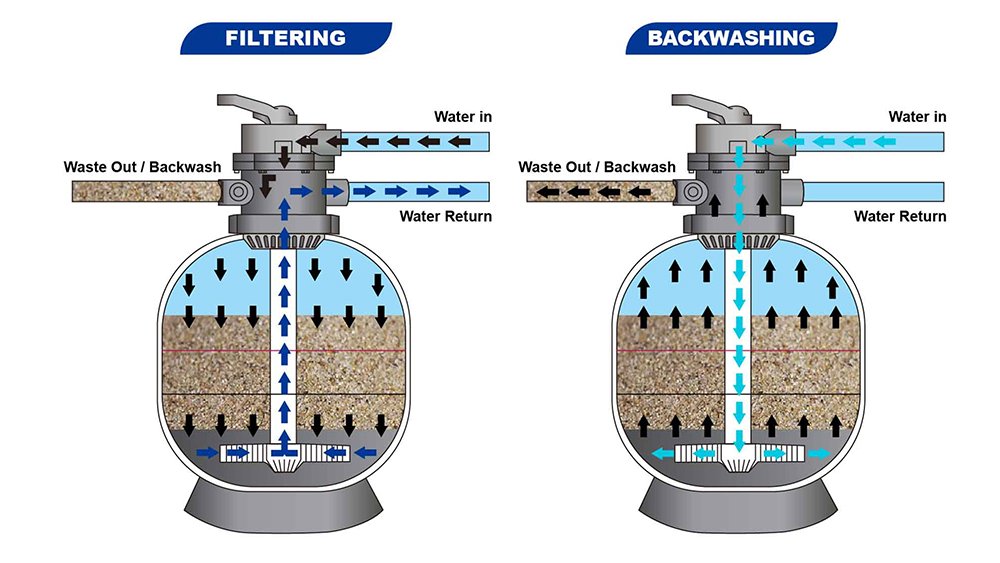
Sand filters clean themselves through a process called backwashing — you reverse the flow of water through the tank, which flushes trapped debris out through a waste line. You backwash when the filter pressure gauge reads 8–10 PSI above its normal baseline. In South Florida, with heavy pool use and higher debris loads, you might backwash every 2–4 weeks.
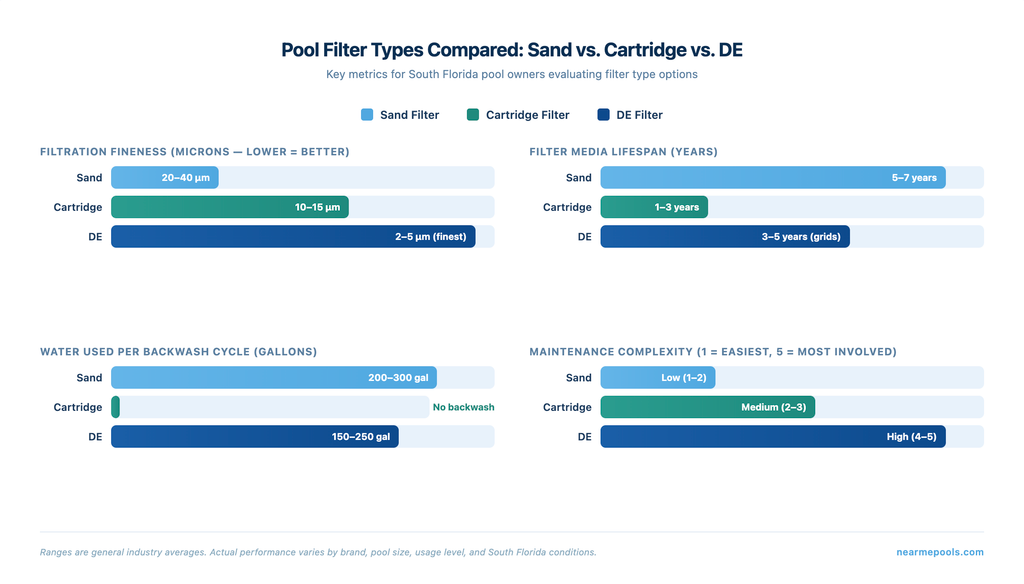
The sand media itself doesn’t need to be replaced very often — typically every 5–7 years. Some pool owners upgrade to glass media or Zeo-brite instead of standard sand, which can filter at smaller particle sizes and extend time between backwashes.
The Filtration Trade-off
Standard sand filters capture particles down to about 20–40 microns. That’s adequate for most pools under normal conditions, but it won’t catch the finest debris — including some algae spores. In South Florida’s warm climate, where algae blooms can develop quickly, this matters.
Pros and Cons at a Glance
Pros:
- Lower upfront cost
- Self-cleaning via backwashing
- Simple to operate — easy for homeowners to manage
- Durable tanks that last 15–25 years
Cons:
- Weakest filtration of the three types (20–40 microns)
- Backwashing wastes water — a concern if you’re on well water or are water-conscious
- Less effective against algae and very fine particles
- Media replacement every 5–7 years
Cartridge Filters: The Low-Maintenance Middle Ground
Cartridge filters have gained significant market share over the past decade, and for good reason: they’re quieter to maintain, use no backwash water, and filter at a finer level than sand. If you’ve recently had a pool system installed or upgraded, there’s a good chance it came with a cartridge filter.
How They’re Maintained
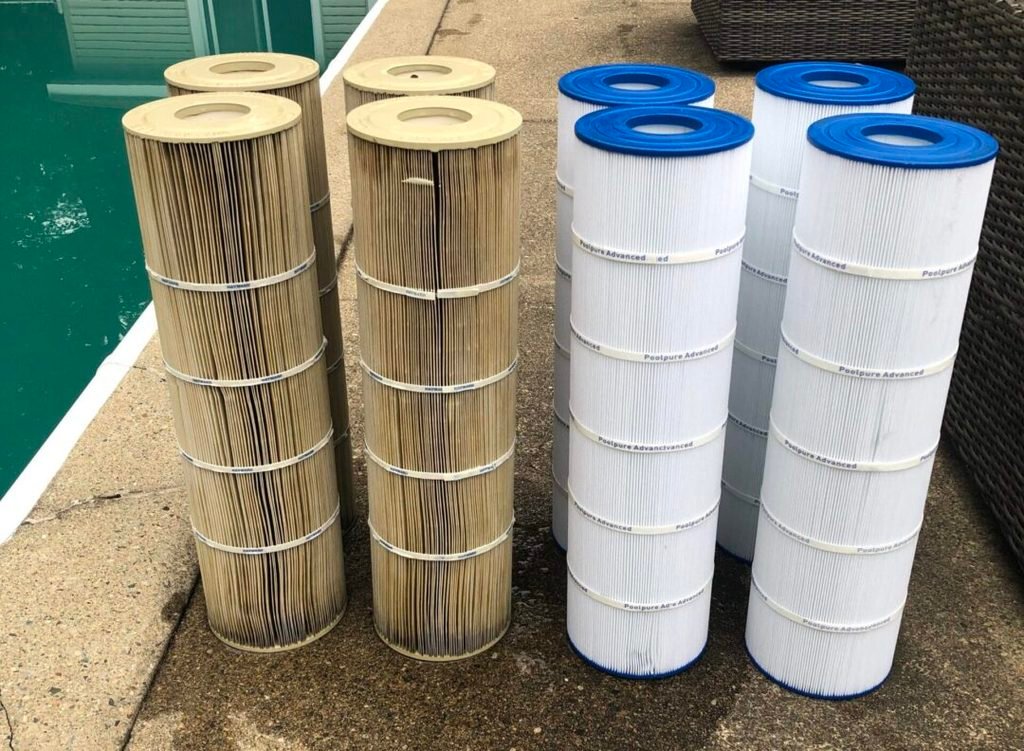
Instead of backwashing, you remove the cartridge element and rinse it with a garden hose — usually every 4–6 weeks during heavy use, or when pressure rises 8–10 PSI above baseline. A more thorough cleaning with a filter cleaner solution should happen every 3–6 months, depending on your pool’s bather load and debris.
Cartridge elements have a finite lifespan — typically 1–3 years before they need to be replaced. Replacement cost varies depending on the brand and size of your system, but this is worth factoring into long-term ownership costs. The good news: no plumbing changes required when you swap a cartridge.
The Filtration Trade-off
Cartridge filters typically capture particles down to 10–15 microns — meaningfully finer than sand but not as much as DE. You’ll notice clearer water, especially during periods when the pool is seeing heavier use or battling minor algae pressure.
Pros and Cons at a Glance
Pros:
- Better filtration than sand (10–15 microns)
- No backwashing
- Quieter system operation (runs at lower pressure)
- Easier to access and rinse for homeowners
- Good fit for water-conscious South Florida homeowners
Cons:
- Cartridge elements need periodic replacement (every 1–3 years)
- Requires more hands-on cleaning than sand (hosing off, soaking)
- Not self-cleaning — you have to remove and clean manually
- Can struggle during heavy algae events without assistance from chemicals
DE Filters: The Gold Standard in Filtration
If filtration quality is the priority, DE filters win — it’s not particularly close. They capture particles down to 2–5 microns, which is fine enough to trap most bacteria and nearly all algae spores. Pools with DE filters tend to have a clarity and sparkle that you can visibly notice.
The trade-off is that DE filters are more involved to maintain. They’re not the right fit for every homeowner, but in the right setup — especially for pools that are heavily used, prone to algae issues, or owned by people who care deeply about water quality — they’re worth it.
How They’re Maintained
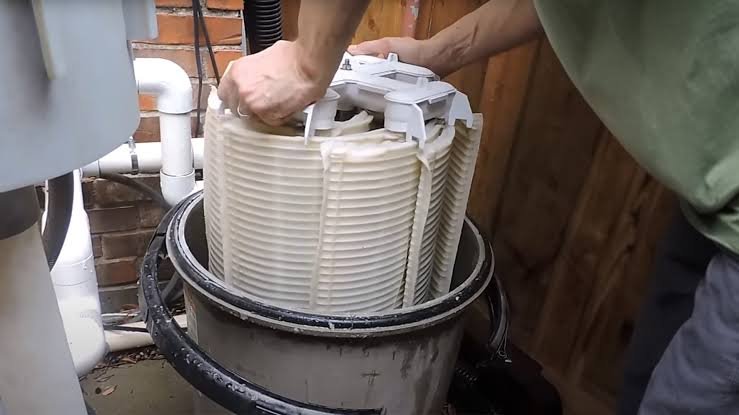
DE filters are backwashed like sand filters, but with an important additional step: after backwashing, you must add fresh DE powder through the skimmer to recoat the filter grids inside the tank. This is where the learning curve comes in. Too little DE and the filter won’t work properly; too much and it can channel and clog.
Once or twice a year, the filter should be broken down and the internal grids inspected, cleaned, and reassembled. This is typically a job for a pool professional — the grids can tear, and a torn grid means DE passes back into the pool (you’ll see white cloudy material in the water).
Pros and Cons at a Glance
Pros:
- Best filtration of any pool filter (2–5 microns)
- Exceptional water clarity
- Excellent performance against algae and fine debris
- Can extend time between chemical treatments in some cases
Cons:
- Most maintenance-intensive of the three types
- Requires adding DE powder after every backwash
- Annual teardown and grid inspection recommended
- DE powder must be handled carefully (wear a mask — it’s fine particulate)
- Higher upfront cost and more complex installation
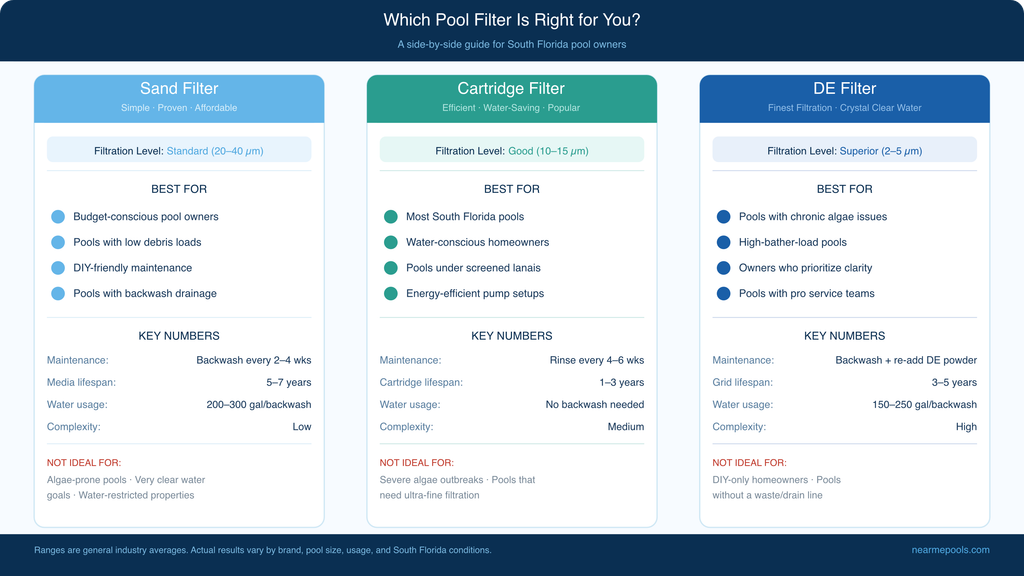
Side-by-Side Comparison
Which Filter Type Is Right for Your South Florida Pool?
The honest answer: it depends on your pool, your lifestyle, and what you value most.
Choose sand if: You want the simplest, most set-it-and-forget-it system, and your pool doesn’t have chronic water clarity or algae issues. Sand is also the most cost-effective entry point if budget is a primary concern. However, we do not recommend it for South Florida pool owners where our climate and year-round use heavily impact its effectiveness.
Choose cartridge if: You want meaningfully better filtration without the complexity of DE, and you’d rather avoid the water waste of backwashing. Cartridge filters are particularly popular in South Florida because they run at lower pressure (easier on the pump) and don’t require a waste line or backwash drainage setup. As a pool company who has handled all types of pools, more than 95% of our customer’s pools use this filtration system
Choose DE if: Water clarity is your top priority, you’re dealing with persistent algae issues, or your pool sees very heavy use (large family, frequent entertaining, spa use). Just go in knowing that the maintenance requirements are real — or plan to have your pool tech handle them.
If your current filter is aging out and you’re not sure which direction to go, it’s worth having a technician assess your pool’s current setup before you commit. The right filter for your pool isn’t always the most expensive one — and the wrong filter for your situation can create more problems than it solves.
If you want guidance on what makes sense for your specific pool and usage patterns, the team at Near Me Pools can walk you through the options and what’s involved in a swap or upgrade.
The South Florida Factor: Why Your Filter Choice Matters More Here
A few things about South Florida pools that affect this decision:
Year-round operation means your filter never gets a break. Systems that work fine in seasonal climates can struggle under continuous, year-round use. This makes durability and maintenance access more important here than in northern states.
High heat accelerates algae growth. Florida’s summer temperatures — and the fact that your pool is warm and inviting to algae all year — puts real pressure on your filtration system. A filter that handles a light suburban load in Ohio might underperform with a full South Florida algae bloom.
Hard water and mineral buildup affect cartridge elements more than sand or DE. If you’re in an area with harder water, plan on more frequent cartridge rinses and the occasional deep soak in a filter cleaning solution to remove calcium and scale buildup.
Screened enclosures reduce large debris load (leaves, insects, bird droppings), which means cartridge filters may stay cleaner longer than they would on an open pool. If your pool is under a screened environment, cartridge is an especially practical choice.
Summary
All three filter types get the job done — the question is how well and how much effort they require from you. Sand filters are the simplest and most affordable but offer the weakest filtration. Cartridge filters hit a practical sweet spot for most South Florida pools: better filtration, no water waste, and manageable maintenance. DE filters deliver the best water quality of the three but require the most attention to keep performing well.
For most homeowners in Broward and Palm Beach County using their pool regularly year-round, a well-maintained cartridge or DE system will produce noticeably better water than aging sand media. If your filter is more than 10 years old and you’re noticing more algae pressure, cloudy water, or higher chemical demand, the filter may be part of the equation — not just the chemistry.
Ready to Figure Out What’s Right for Your Pool?
If your filter is aging, underperforming, or you’re just not sure which direction to go, reach out to our team — we’re happy to take a look at your current setup and give you a straight answer on what makes sense. Near Me Pools serves Broward County and parts of Palm Beach County. Call us at (954) 478-8783 or email contact@nearmepools.com.
Frequently Asked Questions
How often should I clean my pool filter in South Florida?
It depends on the filter type and your pool’s usage. Sand filters typically need backwashing every 2–4 weeks. Cartridge filters should be rinsed every 4–6 weeks and deep-cleaned every 3–6 months. DE filters are backwashed similarly to sand but need DE powder re-added after each backwash. South Florida’s heavy sun and year-round use tend to push these timelines shorter rather than longer.
Can I switch from a sand filter to a cartridge or DE filter?
Yes, and it’s a common upgrade. The equipment swap typically involves replacing the filter tank and sometimes adjusting plumbing connections. It’s not a DIY project — it involves cutting and gluing PVC plumbing under the pool’s pressure system — but it’s a straightforward job for an experienced pool technician.
What is the best pool filter for algae problems in Florida?
DE filters offer the finest filtration (2–5 microns) and will catch algae spores that sand and cartridge filters let pass. If you’re regularly battling algae despite proper chemical treatment, upgrading your filter type may be part of the solution — though it’s worth having your overall system evaluated first, because algae issues often involve more than just filtration.
How do I know when my pool filter needs to be replaced?
Key signs include: pressure gauge reading consistently high even after cleaning or backwashing, water remaining cloudy despite proper chemistry, visible cracks or damage on the tank, or filter grids/cartridge elements that no longer clean up properly. A filter tank that’s 15–20+ years old may simply be past its service life.
Is DE powder safe to use around my family and pets?
DE powder (food-grade or pool-grade) is non-toxic once it settles into the filter. The main precaution is during handling — it’s a fine particulate and you should avoid inhaling it. Always wear a dust mask when adding DE to the skimmer. Once it’s in the system, it poses no risk to swimmers or pets.
Does the type of pool filter affect my chemical usage?
Indirectly, yes. Better filtration means fewer particles in the water — and particles create chlorine demand. A DE filter’s finer filtration can slightly reduce the chlorine needed to maintain clear, balanced water, especially during periods of heavy use or minor algae pressure. The difference isn’t dramatic, but it’s real over time.