

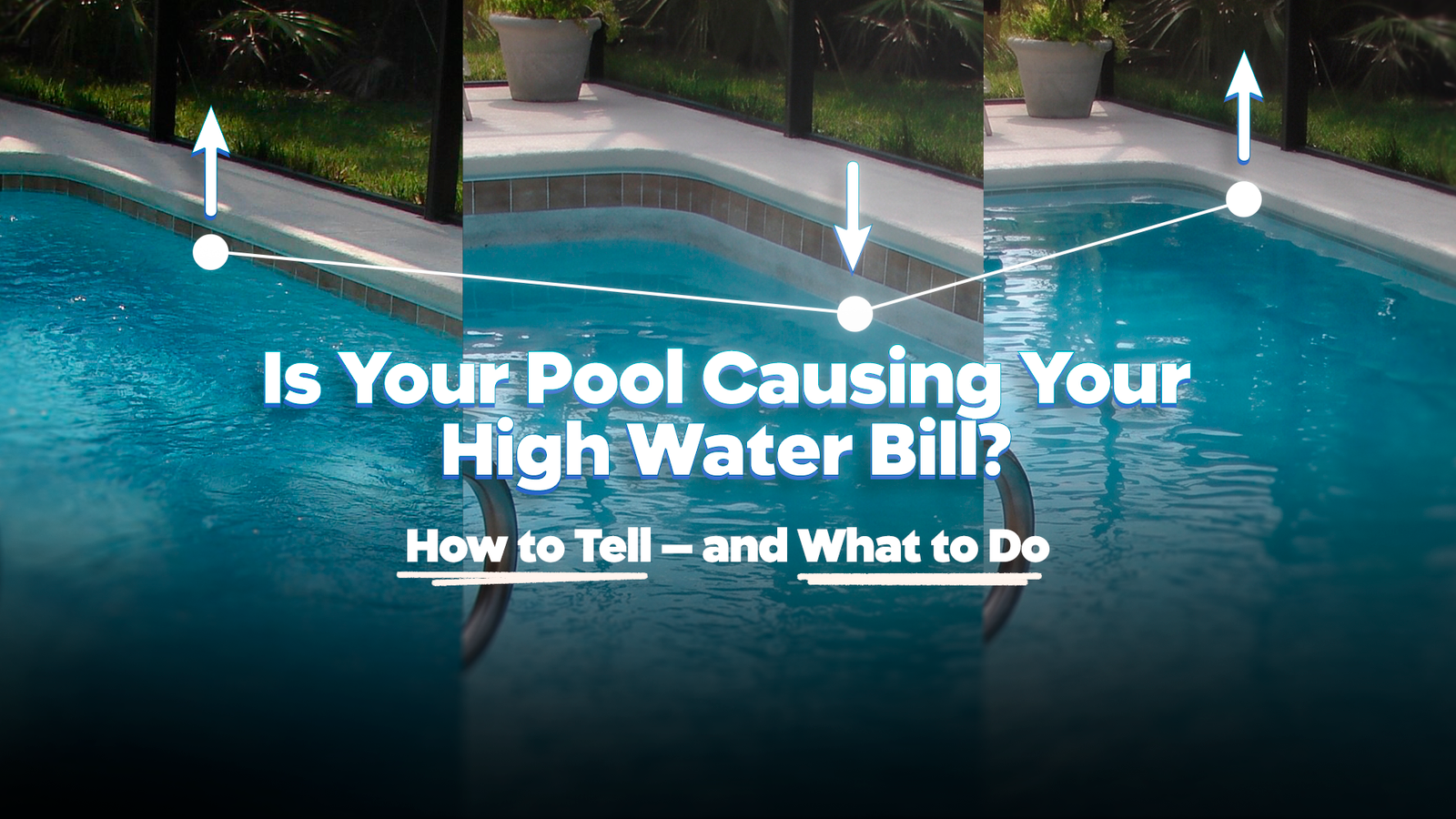
You opened the water bill and did a double-take. The number is higher than usual — maybe a lot higher. You run through the usual suspects: Did someone leave a hose running? Did the irrigation system go haywire? Then your eyes drift to the pool, and a thought creeps in: could that be it?
If you’re a pool owner in South Florida, a pool leak causing a high water bill is one of the most common explanations for an unexpected spike — and also one of the most overlooked. Here’s how to figure out if your pool is the culprit, what to look for beyond the bill itself, and what your next step should be once you know.
How Much Water Does a South Florida Pool Lose to Evaporation?
Before jumping to conclusions, it’s worth understanding what’s actually normal. Pools lose water every day — that’s just physics. The question is how much.
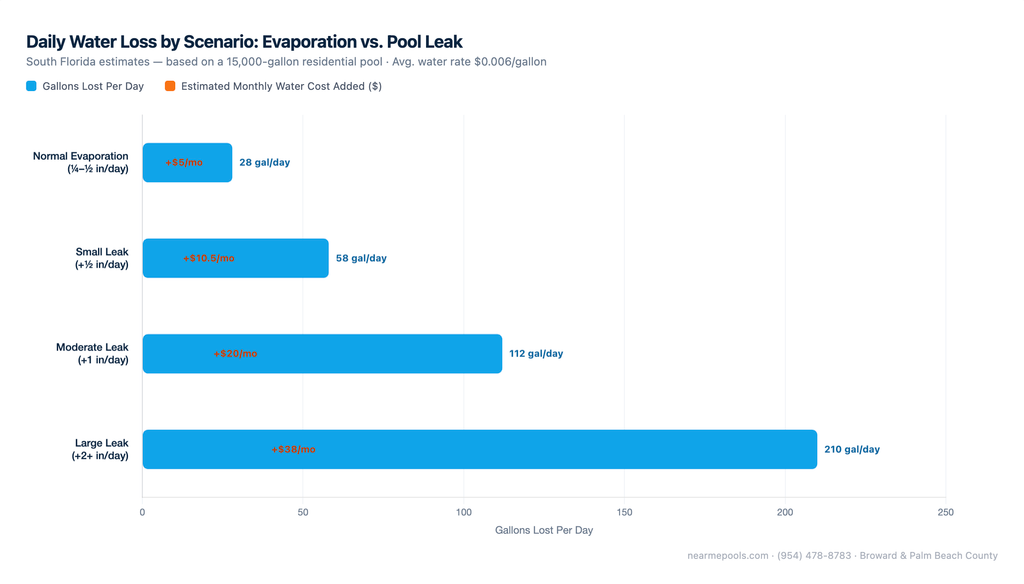
In most parts of the country, a pool might lose ⅛ to ¼ inch of water per day to evaporation. In South Florida, that number is higher. Between the intense heat, strong UV exposure, and year-round use, it’s common for pools here to lose ¼ to ½ inch per day in the summer months — and that adds up fast.
For a standard 15,000-gallon pool, ¼ inch of surface evaporation works out to roughly 20–25 gallons per day. Over a month, that’s 600–750 gallons — just from normal evaporation, before you account for splash-out or backwash.
That said, there’s a ceiling on normal evaporation. When your pool is losing more than about ½ inch per day consistently — or when the loss seems to accelerate despite cooler or cloudier days — evaporation stops being the reasonable explanation.
What a Pool Leak Looks Like on Your Water Bill
Unlike a dripping faucet or a running toilet, a pool leak doesn’t make noise. It doesn’t announce itself. What it does is quietly inflate your water usage month after month.
A few things to look for when you’re reviewing your bill:
A sudden spike with no obvious cause. If your usage jumped by several thousand gallons in a single billing cycle and nothing changed in your household habits, that’s worth investigating. A moderate pool leak can add 1,000–3,000 gallons to your monthly bill. A significant one can add considerably more.
A gradual upward creep over several months. Slow leaks don’t always trigger an obvious one-month spike. Sometimes usage climbs 5–10% per cycle for a few months before it becomes obviously wrong. If your bills have been trending upward without explanation, go back a few months and see if the increase started around the same time you noticed your water level acting inconsistently.
Your auto-fill running constantly. Many South Florida pools have an auto-fill valve that tops off the water to a set level automatically. If you notice it cycling on frequently — or if it seems to run for a long stretch every day — the pool is losing water faster than evaporation would explain.
Before You Call Anyone: Run the Bucket Test
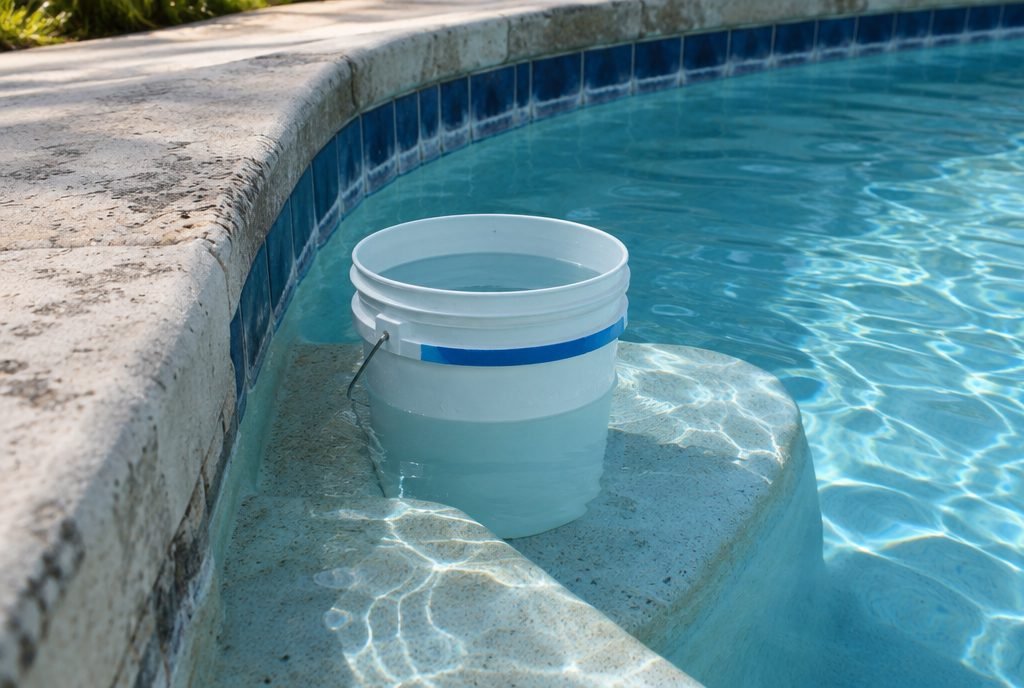
The bucket test is the most straightforward way to distinguish between normal evaporation and a real pool leak. It doesn’t require any tools beyond a 5-gallon bucket, a permanent marker, and 24 hours of patience.
Here’s how to do it:
Step 1: Fill a clean 5-gallon bucket with pool water to about 1 inch from the top. Set it on the first or second step of your pool — submerged a few inches — so both the bucket water and the pool water are exposed to the same temperature and conditions.
Step 2: Mark the water level inside the bucket and the pool water level on the outside of the bucket (or on the pool wall) with a piece of tape or a marker.
Step 3: Turn off your pool’s auto-fill valve. Do not add any water manually.
Step 4: Wait 24 hours. Come back and compare the two levels.
Reading the results:
- If both the bucket and the pool dropped the same amount, that’s evaporation. Normal. No leak.
- If the pool dropped more than the bucket, you have a leak. The difference is your leak rate per 24 hours.
If the pool is losing a full inch more than the bucket over 24 hours, that’s meaningful water loss — and meaningful cost accumulating every single day.
Other Clues Your Pool Is Behind the Bill Spike
The bucket test is a reliable confirmation, but there are other signs worth paying attention to while you’re running it — and before you even pull out a bucket:
Soft or wet spots in your lawn near the pool. If the ground around the pool deck feels spongy, or if a section of grass near the pool is unusually lush or wet when nothing else nearby is, water is ending up somewhere it shouldn’t.
Rust stains or mineral deposits on the equipment pad. Dripping or weeping at fittings, valves, the pump, or the filter housing often goes unnoticed until it leaves staining. A quick look at the equipment pad — especially after the pump has been running a while — can reveal a lot.
Water loss that stops (or slows) when the pump is off. If you notice the pool holds its level better overnight or during periods when the pump isn’t running, the leak is likely in the pressurized plumbing return lines rather than the shell of the pool itself. This is a useful clue for a technician.
Water loss that continues regardless of whether the pump is running. This pattern points toward the pool structure itself — the shell, the light niches, the skimmer throat, or the fittings — rather than the plumbing under pressure.
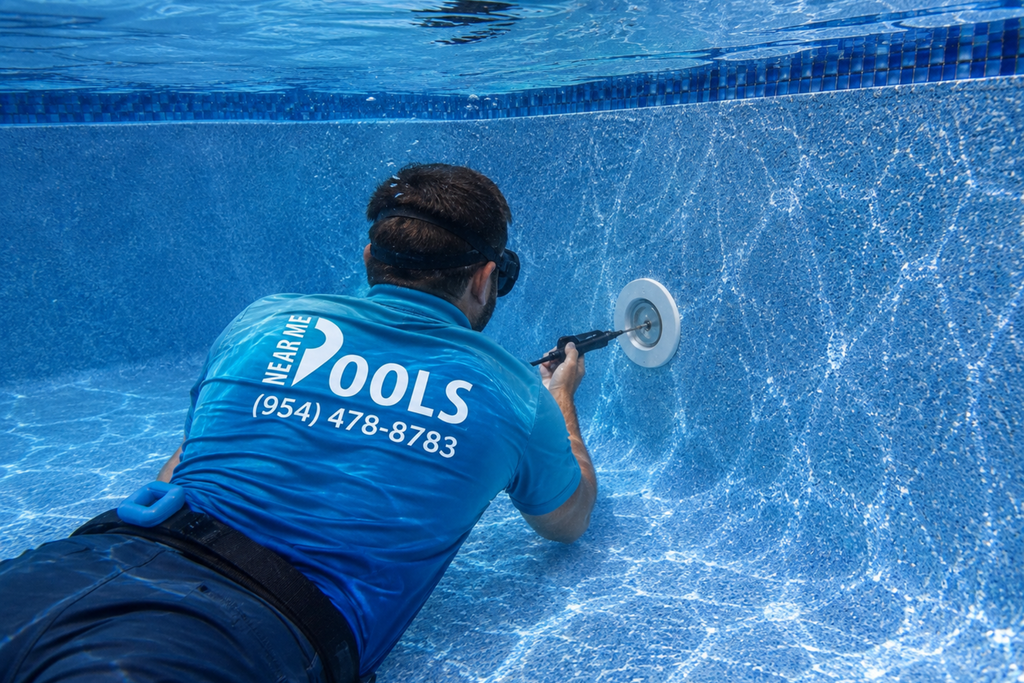
If the idea of a structural leak has you worried, the Near Me Pools leak detection team can isolate exactly where water is escaping — whether it’s the shell, the plumbing, or the equipment — using pressure testing, dye testing, and acoustic detection.
What to Do Once You’ve Confirmed the Pool Is Leaking
The bucket test says your pool is losing more than the bucket. Now what?
First: don’t start probing around the pool yourself trying to find the source. It’s a natural instinct, but professional leak detection exists because leaks are rarely where they appear to be. Water migrates — it follows the path of least resistance through soil, concrete, and plumbing — so the wet spot you’re seeing may be several feet away from the actual source. Digging in the wrong place or disturbing fittings in the process can complicate the diagnosis and the eventual repair.
Second: don’t wait. A leak that’s adding 1,000–3,000 gallons to your monthly water bill is also saturating the soil around your pool, stressing the pool structure, depleting chemicals faster, and potentially affecting your yard and deck. Time matters.
What professional leak detection actually involves — pressure testing the plumbing lines, dye testing visible fittings and surfaces, acoustic and electronic scanning for underground pipe leaks — is more thorough and faster than most homeowners expect. A trained technician with the right equipment can typically isolate the source in a single visit, which is considerably faster than trial-and-error guesswork.
For a full walkthrough of what the process looks like from start to finish, the pool leak detection inspection guide covers exactly what to expect when a technician shows up.
The Bottom Line
A high water bill isn’t always the pool — but when it is, the sooner you figure it out, the less it costs you in wasted water, chemical imbalance, and potential structural damage. Start with the bucket test. It takes 24 hours and costs nothing. If the results confirm what you suspected, the next call is to a professional who can find it quickly and accurately.
South Florida pools run year-round, which means a leak runs year-round too. Don’t let it run up your bill month after month.
Ready to Stop Guessing?
If your bucket test came back positive — or if your water bills have been creeping up and you want answers — Near Me Pools provides professional pool leak detection throughout Broward County and parts of Palm Beach County. We can typically locate the source in a single visit using pressure testing, dye testing, and electronic detection.
Reach out to our team, call us at (954) 478-8783, or email us at contact@nearmepools.com — we’ll give you a straight answer and a clear plan.
Frequently Asked Questions
How much water should a pool lose per day in South Florida?
In South Florida’s heat, normal evaporation typically accounts for ¼ to ½ inch of water loss per day during warmer months. For a standard 15,000-gallon pool, that’s roughly about 20 gallons per day. If you’re losing significantly more than that — especially on cooler or overcast days — it’s worth running the bucket test to rule out a leak.
How do I know if my pool auto-fill is masking a leak?
If your auto-fill valve runs frequently or for long stretches, it may be compensating for water loss you wouldn’t otherwise notice. The easiest check: turn off the auto-fill and watch how fast the pool level drops over 24–48 hours. Then compare that drop to the bucket test. If the pool is dropping faster than the bucket, you have a leak.
Can a small pool leak really cause a big water bill spike?
Yes. A ¼-inch daily leak on a 15,000-gallon pool can add 1,000–2,000 gallons or more to your monthly usage. Depending on your utility rates, that can translate to a meaningful bill increase every cycle — and it compounds over time. The longer it goes unaddressed, the more you’ll pay before it’s fixed.
Why can’t I just find the pool leak myself?
You can often spot symptoms — wet spots, rust stains, visible cracks at fittings — but locating the actual source of a pool leak reliably usually requires pressure testing, dye testing, and sometimes acoustic detection equipment. Water migrates unpredictably through soil and structure, so what you see on the surface is often not where the leak originates. Professional detection is faster, more accurate, and prevents the kind of guesswork that can make repairs more complicated.
How long does a pool leak detection take?
In most cases, a professional pool leak detection inspection can be completed in a single visit. The exact time depends on pool size, the number of plumbing lines, and how quickly the source is isolated — but it’s typically a matter of hours, not days.