

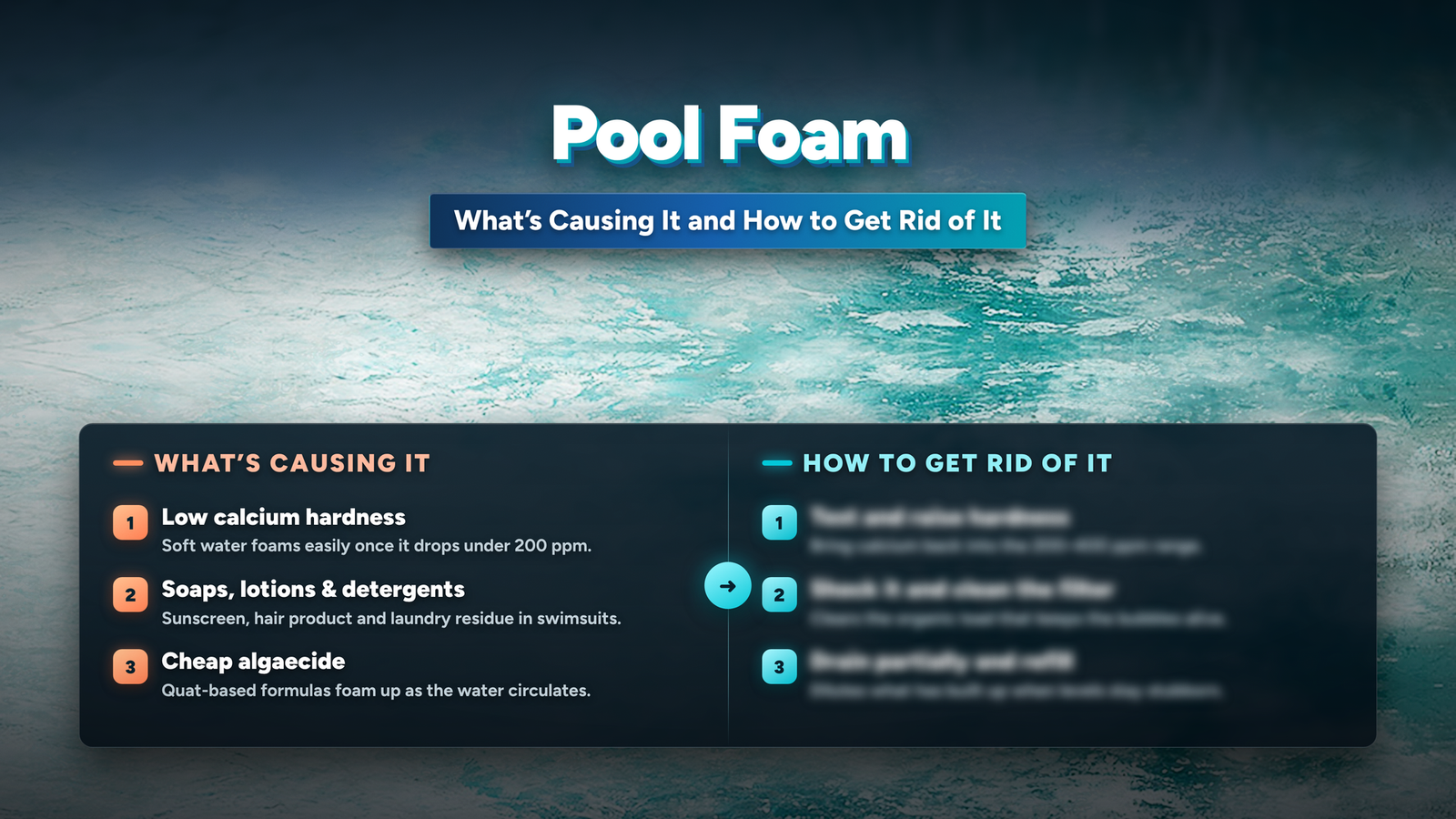
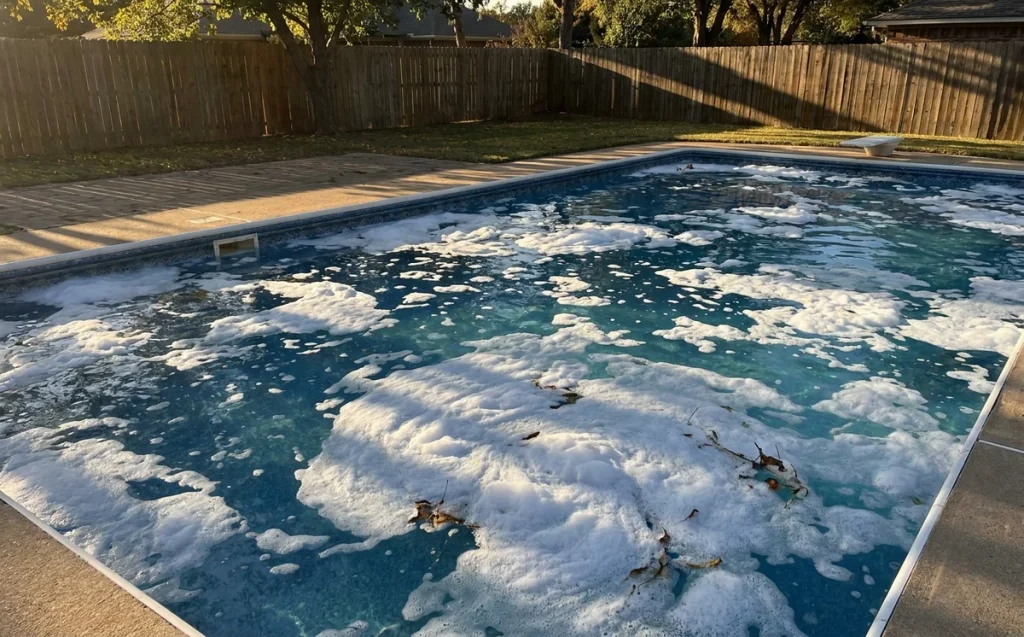
You went out to check on the pool and something looked off. There’s a layer of white foam sitting on the surface — maybe a thin fringe near the jets, maybe a thick blanket across half the water. It wasn’t there yesterday. Now you’re wondering if you added something wrong, if your water is contaminated, or if something just broke.
The good news: pool foam is almost always fixable without draining your pool. The less-good news: foam is usually a sign that something in your water chemistry is off, and ignoring it typically makes the underlying problem worse. So let’s figure out what you’re actually dealing with.
Why Pool Foam Forms in the First Place
Foam in water happens when the surface tension breaks down enough for air bubbles to hold together instead of popping immediately. In a normal pool, water’s surface tension is high enough that bubbles pop almost as fast as they form. When you have foam that lingers — especially thick, suds-like foam — it means your water contains surfactants: substances that lower surface tension and allow bubbles to stick around.
That’s the underlying science. What actually introduced those surfactants into your pool? That’s the real question, and the answer narrows down your fix.
The Most Common Causes of Pool Foam
1. Body Oils, Sunscreen, and Lotions
This is the most common cause of foamy pool water, especially in the summer months when pool use picks up. Every person who gets in the water brings with them a cocktail of sunscreen, body lotion, hair products, and natural skin oils. Over time — especially in a pool that sees heavy use without a proper cleaning schedule — these substances build up in the water and start affecting surface tension.
A light foam that forms quickly after a pool party and clears up within a day usually points here. It’s not a chemistry problem so much as a contamination load issue.
What helps: Shock the pool to oxidize the organic material. Running the filter for a full 24-hour cycle after heavy use helps too. Encouraging swimmers to rinse off before getting in goes a long way over time.
2. Cheap or Overused Algaecide
Some algaecides — particularly the quaternary ammonia (“quat”) variety — are known to cause foam, especially if you’ve been adding them regularly or at a higher dose than directed. The algaecide itself is a surfactant by nature. That’s partly how it works against algae. But it also means it can leave your water foamy for a day or two after treatment.
Foam that shows up specifically after you’ve added algaecide is almost always this cause. It tends to be lighter and dissipates on its own within 24–48 hours as the algaecide is consumed.
What helps: Let it run its course. Switch to a copper-based or polyquat algaecide in the future — they’re far less likely to cause foam. And don’t overdose: more algaecide is not always better.
3. Low Calcium Hardness
This one surprises a lot of homeowners. Calcium hardness — the concentration of dissolved calcium in your water — plays a big role in how stable your water is at the surface. When calcium hardness drops too low (below 150–200 ppm), the water becomes “soft” and is more prone to foaming. Low-hardness water also tends to be corrosive and can damage pool surfaces and equipment over time, so fixing it is worth doing regardless of the foam.
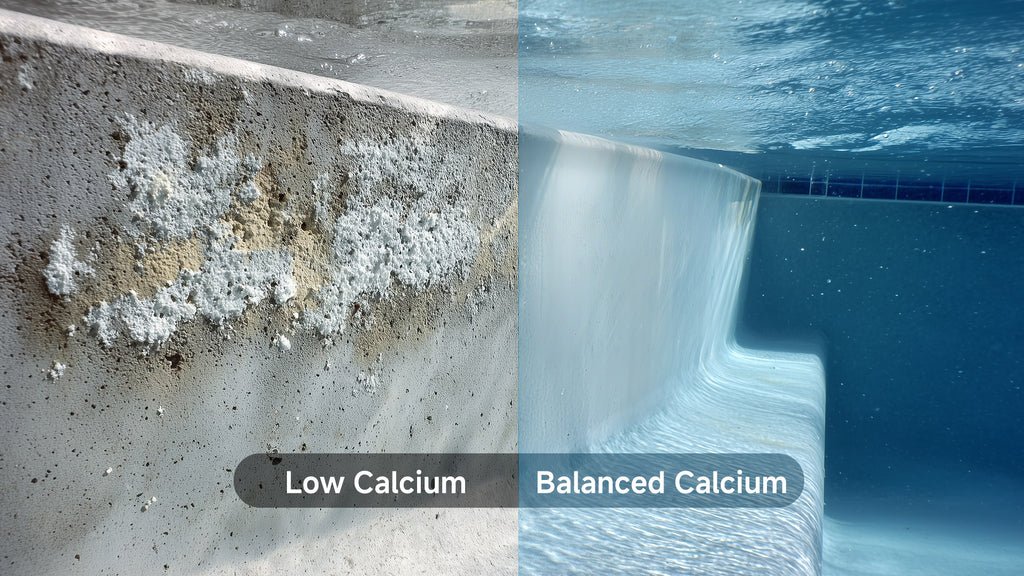
In South Florida specifically, calcium hardness issues can go both ways — we have areas with hard water that leads to mineral buildup, and areas where refilling with soft water can dilute calcium levels. If you’ve recently added a lot of fresh water (after a dilution or post-storm top-off), check your calcium hardness first.
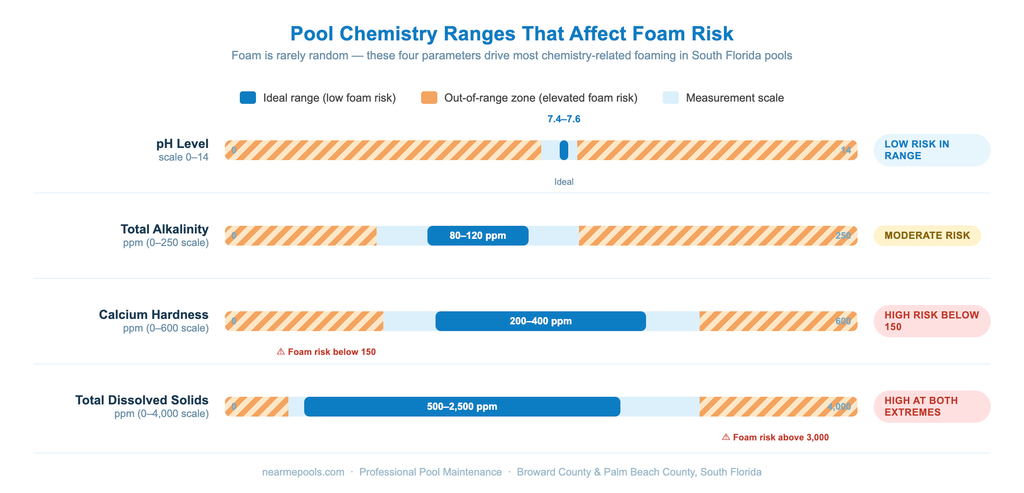
Ideal range: 200–400 ppm for most pools. If you’re below 150 ppm, add calcium chloride to bring it up gradually.
What helps: Test calcium hardness with a reliable kit or take a sample to a pool store. Add calcium chloride according to the instructions based on your pool volume. Don’t try to raise it more than 50 ppm per day.
4. Low Total Dissolved Solids (TDS) — or Very High TDS
TDS is the total concentration of dissolved substances in your pool water: minerals, chemicals, organic material, everything. Both ends of the TDS spectrum can cause foaming, though for different reasons.
Very low TDS (under 500 ppm) means the water lacks the mineral density to maintain stable surface chemistry. Very high TDS (above 2,500–3,000 ppm) means the water is oversaturated with dissolved solids and can’t properly support chemical reactions — which leads to instability and, sometimes, foam.
High TDS is common in pools that haven’t been partially drained and refilled in several years, especially in South Florida where year-round use and frequent chemical additions accumulate over time.
What helps: For high TDS, partial drain and refill is usually the best solution. For low TDS, the fix often overlaps with addressing calcium hardness and overall chemistry balance. A water chemistry test that includes TDS will tell you where you stand.
5. Detergent or Soap Contamination
This one is less common but worth knowing: if someone accidentally added dish soap, laundry detergent, or a cleaning product near or into the pool, you’ll see heavy, suds-like foam that doesn’t go away on its own. The same can happen if someone washed a pool toy, floaties, or a swimsuit with detergent and didn’t rinse it well.
Heavy, persistent, sudsy foam that appeared suddenly and isn’t tied to chemical additions usually points here.
What helps: This is one of the harder situations to fix without a partial drain. Running the filter continuously and using an anti-foam product can reduce it temporarily, but detergent contamination often requires diluting the pool water with fresh water to truly resolve. If the foam is extreme and persistent, partial drain and refill may be the fastest path forward.
How to Diagnose Which Cause You’re Dealing With
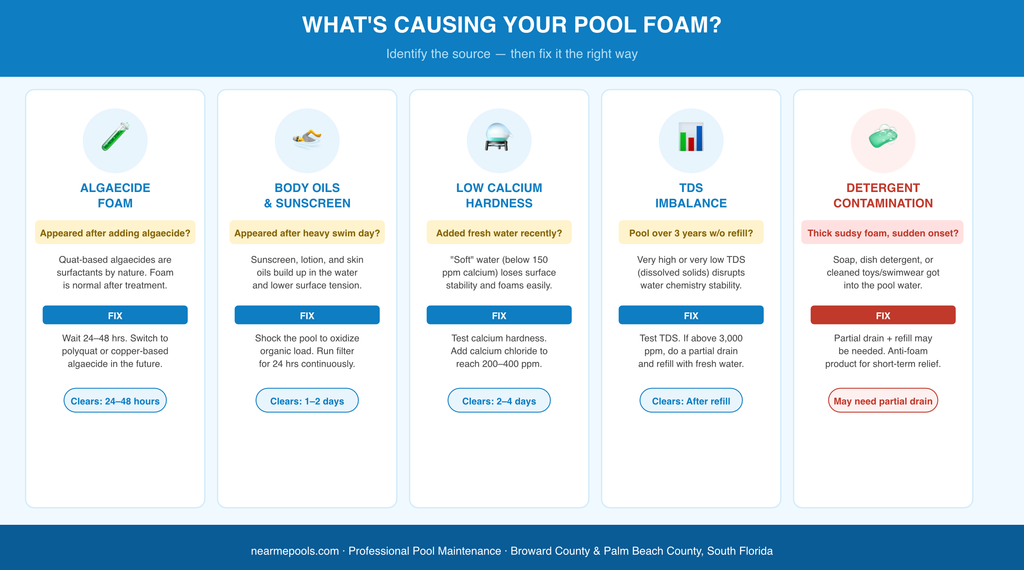
Here’s a quick way to narrow it down:
- Foam appeared right after algaecide addition? Wait 24–48 hours. If it clears, that was your answer.
- Foam appeared after a pool party or heavy swim day? Shock and run the filter overnight.
- Foam is thick, sudsy, and persistent? Suspect detergent. Consider whether anyone cleaned a toy, floaty, or swimsuit without rinsing.
- Foam appeared after filling with fresh water? Test calcium hardness and TDS immediately.
- None of the above? Run a full water chemistry panel — calcium hardness, TDS, pH, alkalinity, and chlorine. Foam that doesn’t have an obvious source is almost always a chemistry issue at its root.
How to Fix Pool Foam — Step by Step
Step 1: Test your water first. Before adding anything, know what you’re working with. pH, alkalinity, calcium hardness, and TDS are the four readings most relevant to foam. If you don’t have a reliable test kit that covers calcium hardness and TDS, grab a sample and take it to a pool supply store — most will test it for free.
Step 2: Identify and remove the source. If it’s algaecide, stop adding it until the current dose is consumed. If it’s body oils, shock the pool to oxidize the organic load. If it’s detergent, identify how it got in and remove whatever introduced it.
Step 3: Adjust chemistry to target ranges. Bring calcium hardness to 200–400 ppm, pH to 7.4–7.6, and total alkalinity to 80–120 ppm. A balanced pool is a resilient pool.
Step 4: Run your filter. Regardless of cause, running your filter continuously for 24–48 hours while you address the chemistry helps clear the water faster.
Step 5: Use an anti-foam product sparingly. Anti-foam additives (available at pool supply stores) reduce the visible foam quickly, but they don’t fix the underlying cause. Use them only as a short-term measure while you address the root issue, not as the solution.
When the Foam Keeps Coming Back
If you fix the foam and it comes back within a week, you’re dealing with a recurring chemistry imbalance — not a one-time event. In South Florida’s heat and year-round swim season, water chemistry drifts faster than it does in cooler climates. Pools that aren’t being tested and adjusted consistently are more prone to the kinds of imbalances that lead to foam, cloudy water, and algae.
A professional pool maintenance service catches these issues before they become visible problems. A technician testing your water weekly can spot calcium hardness creeping down or TDS climbing before either one causes you a headache.
The Bottom Line on Pool Foam
Foam is your pool’s way of telling you something is off. It’s usually not serious on its own, but it’s worth paying attention to — because whatever’s causing the foam is also affecting your water’s overall stability, your equipment’s longevity, and the comfort of everyone who swims in it.
Most foam situations resolve quickly once you identify the cause: algaecide foam disappears on its own, body oil foam responds to shocking, and chemistry-based foam clears up once you bring calcium hardness and TDS back into range. Detergent contamination is the one scenario that might require more aggressive intervention, but even that’s manageable with the right approach.
If you’re dealing with recurring foam — or recurring anything — and you’d rather hand that off to someone who tests and balances the water every single week, Near Me Pools serves Broward County and parts of Palm Beach County. You can reach out to our team here, give us a call at (954) 478-8783, or email us at contact@nearmepools.com. We’re happy to take a look at your water and give you a straight answer.
Frequently Asked Questions
Is pool foam dangerous to swim in?
In most cases, no — mild foam from body oils or algaecide isn’t a health risk. However, if the foam is caused by a detergent contamination or signals a serious chemistry imbalance, it’s better to hold off on swimming until the issue is resolved. When in doubt, test your water before jumping in.
How long does algaecide foam last?
Algaecide foam typically dissipates within 24–48 hours on its own as the algaecide gets consumed in the water. Running your filter during that window helps speed it up. You don’t need to add anything to counteract it — just give it time.
Can I use anti-foam products in my pool?
Yes, pool-safe anti-foam additives are available at pool supply stores and are safe to use. Just understand that they reduce the visible foam without fixing what’s causing it. Use them as a short-term measure while you address the root cause, not as a standalone solution.
My pool foams every time the jets are running — is that normal?
A small amount of surface agitation from jets can create a brief, thin fringe of bubbles that disappears quickly. That’s normal. If it’s thick foam that persists after the jets stop, or builds up along the surface over time, it’s a sign of a chemistry issue worth investigating.
Can low calcium hardness really cause foam?
Yes. Calcium hardness below 150–200 ppm significantly increases the likelihood of foam because the water loses surface stability. It’s also corrosive to pool plaster, tile grout, and metal equipment — so fixing low calcium is worth doing for more than just the foam. The pool maintenance team at Near Me Pools checks calcium hardness as part of regular water testing.
How do I prevent pool foam from coming back?
Consistent water chemistry is the best prevention. Test weekly, maintain calcium hardness between 200–400 ppm, keep pH at 7.4–7.6 and alkalinity at 80–120 ppm, and shock after heavy swim days. Encouraging swimmers to rinse off before getting in reduces the organic load that contributes to foam over time.
Near Me Pools provides professional pool cleaning and maintenance services across Broward County and parts of Palm Beach County. Learn more about our maintenance plans or contact us to get started.