

Your electric bill shows up and there’s a number on it that makes you do a double-take. You’ve been running the pool pump a lot. What you might not know is that the pump is almost certainly the single largest energy consumer in your home’s outdoor setup. If it’s a single-speed model (and most pools built before 2015 still have one), it’s been running at full throttle every hour of every day if you don’t have a timer installed, regardless of whether your pool actually needed that right now.
A variable speed pump changes that equation — sometimes dramatically. But it’s still a real investment, and the last thing you need is a vague promise that it “pays for itself.” Here’s an honest breakdown of what these pumps actually do, what the energy savings look like, and how to decide if the upgrade makes sense for your pool.
What Is a Variable Speed Pool Pump — and What Makes It Different?
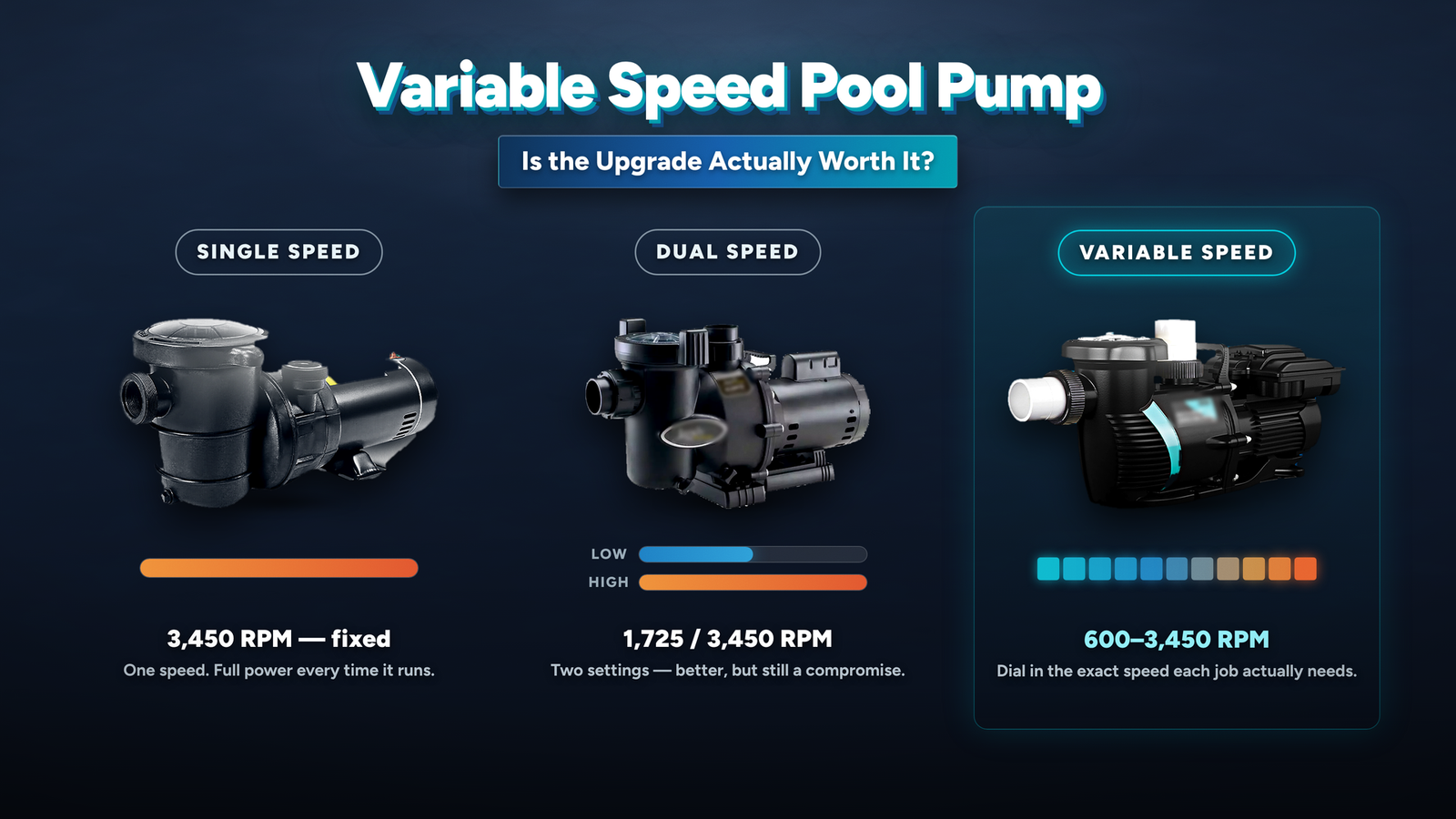
A traditional single-speed pump does exactly what the name implies: it runs at one speed, full power, all the time. It’s simple and reliable, but completely inflexible. Every hour it operates, it draws the same amount of electricity — whether your pool is crystal clear and needs gentle circulation or you’re running a cleanup cycle after a big storm.
A variable speed pump (VSP) has a programmable motor that can run at different RPMs depending on what your pool needs at any given time. A general circulation cycle might run at 1,500–2,000 RPM. A filter backwash or spa jet function might briefly run at 3,000+ RPM. Overnight, when you just need the water moving to prevent stagnation and chemical stratification, it might tick along at 1,000 RPM or lower.
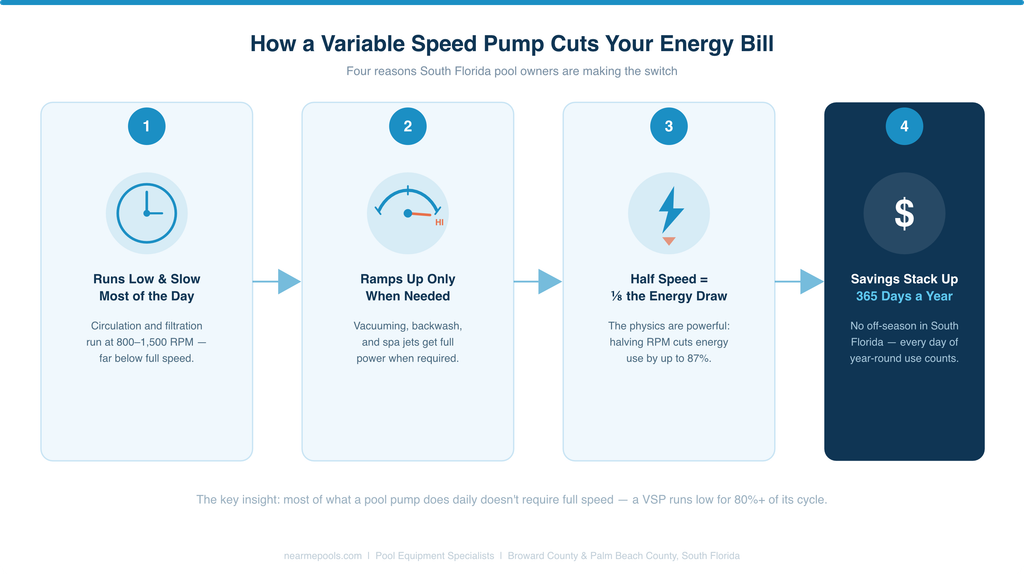
Here’s the key physics: the relationship between motor speed and energy consumption is not linear — it’s exponential. Running a pump at half speed doesn’t use half the energy; it uses roughly one-eighth of the energy. That’s the fundamental reason variable speed pumps can deliver significant savings on a typical pool’s electricity bill.
Why This Matters More in South Florida Than Almost Anywhere Else
The energy argument for variable speed pumps is compelling in any climate. In South Florida, it’s even stronger — for a few reasons.
Year-round operation. In most of the country, pools close for 4–6 months in winter. Pump savings in those climates are seasonal. Here, your pump runs 12 months a year. There is no off-season. Every efficiency gain compounds across 365 days instead of 180.
Longer daily run cycles. South Florida’s heat, UV intensity, and year-round pool use mean most homeowners here run their pumps 8–12 hours a day — sometimes more during peak summer months when algae pressure is highest. That’s more hours on the pump clock compared to seasonal climates, which means more hours where the efficiency difference shows up on your bill.
Electricity rates. South Florida utility rates are not the cheapest in the country, and they’ve trended higher in recent years. Running a high-draw single-speed pump for 10+ hours daily in that environment adds up quickly.
Algae season. Summer in South Florida means heat, humidity, and heavy sunlight — all of which accelerate algae growth and chlorine burn-off. Many pool owners increase their pump run times during the summer months, which is exactly when the efficiency difference between single-speed and variable-speed becomes most pronounced.
What the Energy Savings Actually Look Like
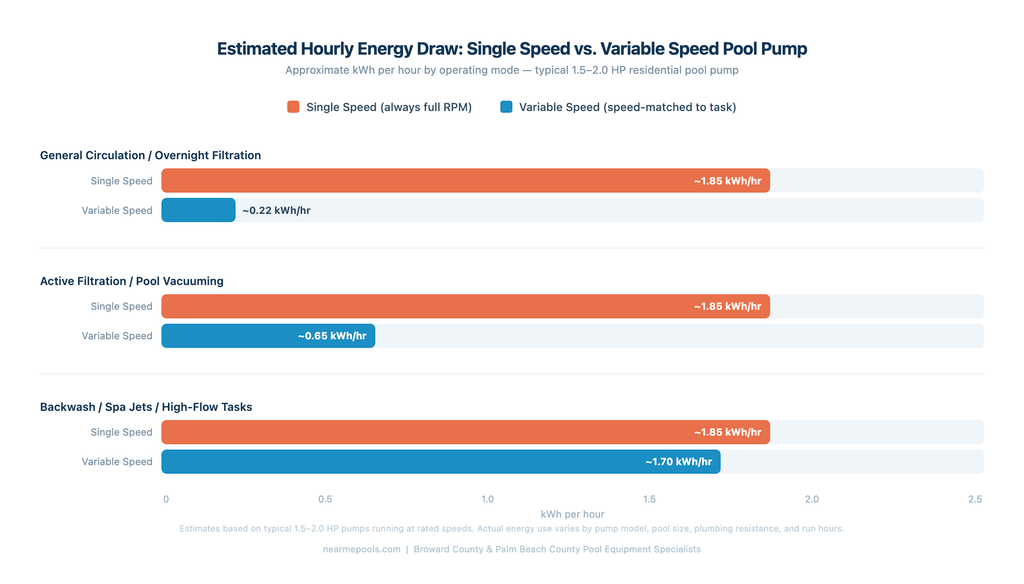
Exact numbers depend on your specific pump model, pool size, daily run hours, and local utility rates — which is why we’re not quoting specific dollar amounts here. But the directional picture is consistent: most South Florida homeowners who switch from a single-speed to a variable-speed pump see a meaningful reduction in the portion of their electric bill attributable to pool equipment.
The reason is simple: most of what a pool pump does throughout the day — general filtration and circulation — doesn’t require the pump to run at high speed. High-speed operation is only needed for specific tasks like vacuuming, backwashing, or running spa jets. When a VSP is programmed correctly, it runs low and slow for the bulk of its cycle and ramps up only when necessary.
The Payback Period Question
The honest answer is: it depends on how much your current pump costs to run. A VSP costs more upfront than a single-speed replacement — that’s just true. But the question isn’t what it costs upfront; it’s how quickly the energy savings offset that difference.
For South Florida homeowners running a single-speed pump 10+ hours a day year-round, the math often works out favorably — typically within a few years, depending on your current energy usage and rates. And once the pump has paid for itself through savings, you’re ahead every year after that for the life of the unit.
Near Me Pools can walk you through the options based on your pool’s specific setup — whether a VSP makes clear financial sense in your situation, or whether a different approach is the better call. If the numbers don’t work, we’ll tell you that too.
Other Benefits Beyond Energy Savings
Energy savings get the most attention in variable speed pump discussions, but there are a few other advantages worth knowing about.
Quieter operation. Variable speed pumps running at low RPMs are noticeably quieter than single-speed pumps at full throttle. If your equipment pad is near a patio, lanai, or bedroom window, the noise reduction is genuinely noticeable — especially during overnight low-speed cycles.
Longer equipment life. Running at lower RPMs puts less mechanical stress on the pump motor, impeller, and seals. Less stress generally means longer component life. South Florida’s heat is already hard on equipment; anything that reduces wear is a meaningful consideration.
Better water quality. Longer, slower filtration cycles — which become practical with a VSP because the energy cost is low — often produce better water clarity than shorter, high-speed cycles. Water moving slowly through a filter medium gets more contact time with the filtering material.
Compatibility with automation systems. If you’re considering adding a pool automation controller (or already have one), variable speed pumps integrate cleanly with most systems. You can program speed profiles by time of day, tie them to your solar heater schedule, or set them to ramp up automatically for specific tasks. The two upgrades pair well.
What to Know Before Replacing Your Pump
If you’re thinking about making the switch, a few practical notes:
Your current pump’s condition matters. If your single-speed pump has years of life left, that factors into the timing decision. If it’s already showing signs of wear — unusual noise, frequent priming issues, age beyond 10 years — the replacement decision becomes simpler.
Sizing needs to be right. A variable speed pump that’s undersized or oversized for your pool won’t perform as expected, and won’t hit the energy-saving potential it’s capable of. This is one reason installation by a knowledgeable technician matters — it’s not just swapping one pump for another.
Programming it correctly makes all the difference. A VSP that’s programmed to run at high speed all day is just an expensive single-speed pump. The savings come from setting appropriate speed profiles for your pool’s specific needs, and that programming is something a technician can set up correctly from day one.
Electrical connections are not DIY territory. Pool pump installation involves hardwired 240V electrical connections. This is not a job to improvise. Beyond the safety risks, an incorrect installation can void the manufacturer’s warranty on the new pump. Always have a licensed pool equipment technician handle the swap.
Is It Right for Your Pool?
Variable speed pumps aren’t the right call for every situation, but for most South Florida homeowners with a single-speed pump and a pool that runs year-round, the case is strong. The best way to know for certain is to have someone who knows your specific equipment take a look and give you a straight answer.
Variable speed pumps reduce energy costs by running at lower RPMs for the majority of their daily operation — a savings that compounds fast in South Florida’s year-round pool climate. They also run quieter, extend equipment life, and play nicely with pool automation systems. The upfront cost is real, but for most homeowners running a single-speed pump heavily year-round, the math often works in their favor within a few years.
The decision comes down to your current pump’s age and condition, your daily run hours, and your energy rates. A knowledgeable technician can help you look at those numbers honestly before you commit.
If you’re ready to stop wondering whether a VSP upgrade makes sense and want a straight answer for your specific pool, reach out to our team at Near Me Pools. We serve Broward County and parts of Palm Beach County and handle everything from the assessment to the installation.
Give us a call at (954) 478-8783 or email us at contact@nearmepools.com — we’ll take a look at your setup and give you an honest read on what makes sense.
Frequently Asked Questions
Can I install a variable speed pump myself to save money?
The programming and mounting are relatively straightforward, but the electrical connection — 240V hardwired — is not a DIY task. Beyond the safety concern, an improper electrical installation can void the manufacturer’s warranty on a pump that may cost several hundred dollars. Have a licensed pool equipment technician handle the install, and have them set up the speed profiles correctly from day one.
My single-speed pump is only 4 years old and still working fine. Should I replace it now?
Probably not yet — unless your energy bills are noticeably high and you’re running the pump 10+ hours a day. If the current pump has years of life left, it often makes more sense to wait until it’s ready for replacement and upgrade at that point. The right time to plan the switch is now, so you’re informed when the moment comes, rather than making a rushed decision after an unexpected failure.
Does a variable speed pump work with my existing plumbing and filter?
In most cases, yes. Variable speed pumps are generally compatible with existing plumbing setups, though proper sizing to your pool’s flow requirements matters. The plumbing connections and filtration system don’t typically need to change — it’s primarily the pump unit itself being swapped. A technician can confirm compatibility with your specific setup before any work is done.
What brands of variable speed pumps does Near Me Pools recommend?
For reliability we recommend leading equipment brands including Pentair, Hayward, and Jandy — the same names you’ll see on most South Florida pools. Rather than steering you toward a specific brand, we look at your pool’s size, existing plumbing, and setup to recommend what fits best. Reach out to our team to discuss what some best options look like.
Will a variable speed pump work with my pool automation system?
Yes — in fact, variable speed pumps and pool automation systems are designed to work together well. Most current VSPs from major brands (Pentair, Hayward, Jandy) are compatible with popular automation controllers. If you’re considering both upgrades, doing them together is often more efficient than adding them separately.