

You walked out to the pool, checked the temperature, and it’s the same as the tap. The heater’s been running — or at least, you thought it was — but the water is cold. Or maybe the heater kicked on, ran for a few minutes, then shut itself off. Or the display is showing a code you’ve never seen before and you have no idea what it means.
Whatever brought you here, the good news is: a pool heater that stops working often has a straightforward reason behind it. The frustrating news is that diagnosing it correctly — and fixing it safely — isn’t always a DIY job. But understanding what’s happening before you call a technician puts you in a much better position to get it resolved quickly and without guessing games.
Start Here: The Basic Checks Before Assuming a Failure
Before jumping to conclusions about a broken heater, run through these first:
Check the thermostat setting. It sounds obvious, but pool heaters get bumped more often than you’d think — especially if you have automation controls or a mobile app that multiple people access. Make sure the set temperature is actually higher than the current water temperature. A heater won’t run if the water is already at or above the target.
Check the timer and schedule. If your heater runs on a timer (standalone or through an automation system), confirm it’s scheduled to run during the hours you’re expecting it. A misconfigured schedule is one of the most common “the heater isn’t working” calls that turns out to be a settings issue.
Check the circuit breaker. Pool heaters — especially electric heat pumps — draw significant power. If the breaker tripped, the unit won’t run at all. Reset it once and see if it holds. If it trips again, stop and call a technician — a breaker that repeatedly trips is telling you something is wrong with the electrical draw, not just the breaker itself.
Check the gas supply (gas heaters only). If you have a gas heater, confirm the gas supply valve near the unit is fully open. Also check whether other gas appliances in your home are working — if they’re not, you may have a supply issue that’s unrelated to the heater itself.
Check water flow. Most heaters require a minimum flow rate to operate safely. If your pump speed is set too low, or if there’s a restriction in the system (clogged filter, closed valve), the heater’s flow switch may prevent it from firing at all.
If all of that checks out and the heater still isn’t working, you’re likely dealing with an actual equipment issue. Here’s what to look for next.
Common Reasons a Pool Heater Stops Working
Flow and Pressure Issues
This is one of the most frequent causes of a heater that won’t fire — and it’s often mistaken for a heater problem when the real culprit is somewhere else in the system.
Pool heaters are designed with a flow switch (sometimes called a pressure switch) that acts as a safety interlock. If water isn’t moving through the heater at the required rate, the switch prevents the unit from firing. This protects the heat exchanger — a component that can crack or warp if it heats up without proper water flowing through it.
Things that can trigger a flow switch shutoff:
- A dirty or clogged pool filter creating high back-pressure
- A pump running at too low a speed (common with variable speed pumps set to a quiet economy setting)
- A closed or partially closed valve on the return or suction side
- Air in the system after recent plumbing work
If your heater is turning on but shutting off within a minute or two, this is often why. Check your filter pressure gauge — if it’s reading high (typically above 10 psi over your clean baseline), the filter may need to be cleaned or backwashed before the heater will run properly.
Ignition Problems (Gas Heaters)
Gas pool heaters use an ignition system to light the burner — typically an electronic igniter or a hot surface igniter, depending on the model and age of the unit. When ignition fails, the heater will attempt to light, fail, and then lock out after a set number of tries.
Signs of an ignition problem:
- You can hear the heater clicking or attempting to start, but no flame ignites
- The unit runs briefly, then shuts off and shows an ignition fault code
- The burner tray or igniter shows visible carbon buildup, corrosion, or debris
South Florida’s outdoor conditions — humidity, salt air near the coast, insects — can all affect ignition components over time. Wasps and mud daubers are notorious for building nests inside pool heater cabinets, clogging burner orifices and causing ignition failures. A clogged burner is surprisingly common and entirely fixable, but it requires someone to open the unit, clear the obstruction, and verify the gas train is operating correctly.
Do not attempt to manually light a gas pool heater or bypass the ignition system. This is one of those repairs that genuinely needs to be handled by a qualified pool or HVAC technician.
Error Codes and Lockouts
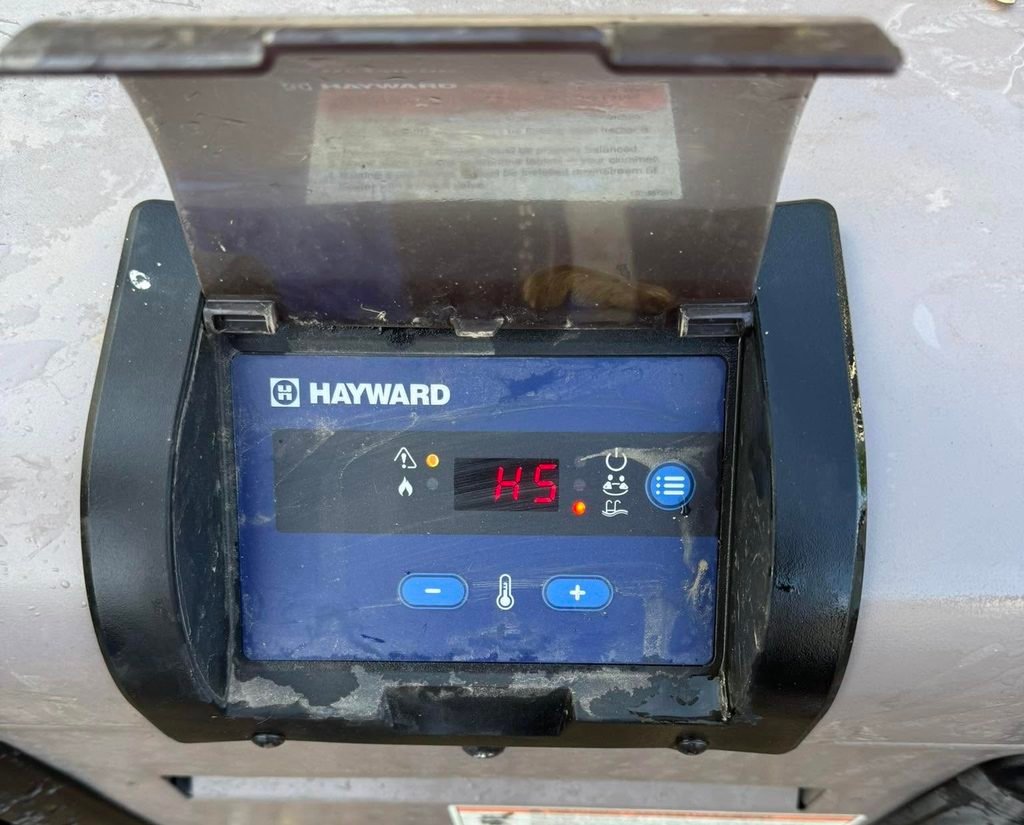
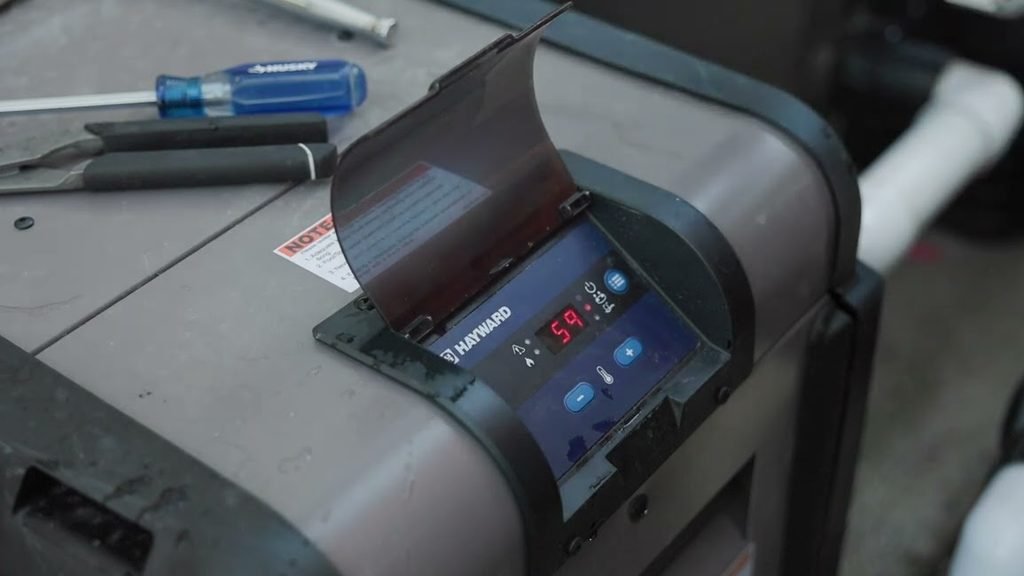
Modern pool heaters — both gas and heat pump — communicate through digital displays that show error or fault codes when something is wrong. If your heater’s display is showing a code, that code is the heater’s way of telling you exactly what it detected before it stopped running.
Common error code categories:
- Flow/pressure faults — The heater isn’t sensing adequate water flow (see above)
- High-limit or overheat faults — The heater shut itself down because internal temperatures exceeded safe operating limits
- Ignition faults — The gas heater attempted to ignite and failed (typically after 2–3 tries)
- Sensor faults — A temperature sensor (water, air, or refrigerant, depending on heater type) is reading out of range or has failed
- Communication errors — In automation-connected systems, the heater may display a fault if it loses communication with the controller
The specific code on your display will vary by brand. Common brands in South Florida include Pentair MasterTemp, Hayward H-Series, Raypak, and Jandy Pro Series for gas; and Pentair UltraTemp, Hayward HeatPro, and AquaCal for heat pumps. Your owner’s manual (or a quick search for “[brand] [model] error code [number]”) will tell you exactly what each code means.
Knowing the code before you call a technician is genuinely useful. Relay that code to your tech — it significantly speeds up diagnosis and may allow them to arrive prepared with the right part.
Thermostat and Sensor Faults
A heater that runs but doesn’t seem to heat — or heats inconsistently — often has a faulty temperature sensor. The heater’s control board relies on temperature readings to decide when to fire and when to shut down. If the sensor is reading incorrectly, the heater may think the water is already at the target temperature when it isn’t, or vice versa.
This is a replacement part job, not a DIY fix — but it’s typically a straightforward repair when the right sensor is sourced for your specific unit.
Heat Exchanger Scale Buildup (Gas Heaters)
This one is more specific to South Florida pools. The region’s water supply tends to be hard — meaning it’s high in calcium and magnesium. When water is heated repeatedly, those minerals can precipitate out and form scale deposits on the heat exchanger’s copper tubes. Over time, scale buildup reduces heat transfer efficiency and can eventually cause the heater to short-cycle or trip the high-limit switch.
The fix depends on how significant the buildup is — light scale can sometimes be addressed chemically; heavy calcification may require heat exchanger cleaning or eventual replacement. This is another reason that regular pool water chemistry maintenance is worth the investment — balanced water is less likely to cause scaling in the first place. If your pool is on a regular maintenance and cleaning schedule, your tech should flag chemistry conditions that could be trending toward scale issues.
Refrigerant Issues (Heat Pumps Only)
If you have an electric heat pump rather than a gas heater, refrigerant is the working fluid that extracts heat from the outside air and transfers it to your pool water. A heat pump that’s running — you can hear the fan and compressor — but producing little to no heat is often dealing with a refrigerant issue.
Signs of a refrigerant problem:
- The heat pump runs continuously but water temperature doesn’t rise
- Ice forming on the evaporator coil (the outdoor-facing section of the unit)
- The unit is producing significantly less heat than it used to at the same ambient temperature
Refrigerant handling requires EPA certification and specialized equipment. This is never a DIY repair. If you suspect a refrigerant issue, the appropriate response is to turn the unit off and call a technician to diagnose and service it.
Gas Heater vs. Heat Pump: Does the Problem Look Different?
Yes — and it matters for troubleshooting.
Gas heaters fail quickly and loudly. When something is wrong with a gas heater, you typically know immediately — it won’t light, it trips a fault code, or it lights and then shuts down. The failure modes are usually ignition-related, gas supply-related, or heat exchanger-related.
Heat pumps fail gradually and quietly. A heat pump with a refrigerant leak or a failing compressor may continue to run for weeks while slowly losing effectiveness — the pool just doesn’t get quite as warm, or takes longer than it used to. Homeowners often attribute this to weather changes before realizing the unit is underperforming. If your heat pump seems to be working but your pool temperature is lower than expected, don’t wait for a fault code — have it inspected.
The bottom line: troubleshoot both types with the same starting checklist, but be aware that heat pump problems often show up as gradual degradation rather than a hard failure.
What to Tell Your Technician
When you call in for a heater repair, the more specific information you can provide, the faster the diagnosis — and the faster you have hot water again. Here’s what to have ready:
- The brand and model number of your heater (usually on a label on the front or side of the unit)
- Whether it’s a gas heater or heat pump
- The exact error or fault code displayed, if any
- What the heater is doing when it fails: won’t start at all, starts and shuts off quickly, runs but doesn’t heat, etc.
- How long you’ve had the heater and roughly when it last serviced
- Any recent changes to the pool system — new pump speed, recent plumbing work, filter cleaning, chemical treatment
That context helps a technician arrive prepared and get to a diagnosis faster.
Summary
A pool heater that stops working is frustrating, but it’s rarely a mystery. Most failures trace back to one of a handful of causes: inadequate water flow, an ignition problem, a fault code lockout, a failed sensor, scale buildup, or — in heat pumps — a refrigerant issue. The first step is always to run through the basics (thermostat, timer, breaker, gas supply, flow), note any error codes, and then call a technician with that information in hand. The more you know about what your heater is doing when it fails, the faster the fix.
When You’d Rather Not Troubleshoot It Yourself
Not everyone wants to crawl around the equipment pad on a hot South Florida afternoon. If your heater isn’t working and you’d rather just have a local pro take a look, Near Me Pools can help pinpoint you in the right direction.
Reach out to our team, give us a call at (954) 478-8783, or email contact@nearmepools.com — we’ll assess the issue, explain what’s going on in plain English, and give you your options. No pressure, no guessing games.
Frequently Asked Questions
Why does my pool heater turn on and then shut off after a few minutes?
This is almost always a flow or pressure issue. Your heater’s flow switch isn’t detecting enough water moving through the unit, so it shuts down as a safety measure. Check your filter pressure — if it’s high, the filter likely needs to be cleaned or backwashed. Also confirm your pump is running at an adequate speed. If flow checks out and the problem continues, it may be a faulty flow switch or a wiring issue — time to call a tech.
My pool heater is showing an error code. Should I reset it?
Write down the code first, then look it up in your owner’s manual or online for your specific brand and model. Some codes clear themselves once the underlying condition is resolved (e.g., a flow fault that clears when you clean the filter). Others require a manual reset. And some indicate a genuine failure that won’t resolve with a reset — in those cases, calling a technician with that specific code in hand will speed up the diagnostic process significantly.
How do I know if my pool heater problem is a repair or a replacement?
Age is the biggest factor. Most gas pool heaters last about 8 years with regular maintenance; heat pumps often last 10 years if well maintained. If your heater is within its expected lifespan and the failure is an isolated component (igniter, sensor, flow switch), a repair usually makes sense. If the heat exchanger is cracked, the compressor has failed, or the unit is approaching the end of its life and needing repeated repairs, replacement may be the smarter investment. Our team at Near Me Pools can walk you through that cost-benefit conversation — reach out here.
Can a pool heater fail because of the weather?
In South Florida, cold snaps aren’t usually an issue — but humidity, salt air (especially near the coast), and Florida’s intense UV exposure can all accelerate wear on heater components. Salt air is particularly corrosive to heat pump coils and gas heater cabinets. Keeping vegetation trimmed away from the equipment pad and ensuring the unit isn’t surrounded by moisture traps can extend its life.
Is it safe to run my pool heater if it’s making an unusual noise or smell?
For gas heaters: if you smell gas or detect a rotten egg odor near the unit, turn off the gas supply valve and do not attempt to operate or troubleshoot the heater. Call your gas provider and a pool technician. Unusual burning smells or electrical odors from a heat pump should also prompt you to shut the unit off and call a technician before continuing to run it. Some noises — like a relay clicking or the fan starting up — are normal. Banging, rattling, or continuous loud humming are not.
How often should a pool heater be serviced?
Annual service is recommended for both gas heaters and heat pumps. A service visit typically includes inspecting the burner assembly and heat exchanger (gas), checking refrigerant levels and coil condition (heat pumps), verifying the flow switch, cleaning the unit, and confirming all safety controls are functional. In South Florida, where heaters may run year-round, skipping annual service is one of the most common reasons heaters fail earlier than expected. At most, try and have it inspected every 2 years.