

The storm passed. The power’s back. You’ve walked the house, checked the roof, picked up half the yard off your patio. And then you look at the pool.
The water level looks lower than it should. Maybe there’s a crack you didn’t notice before. The equipment is making a sound you haven’t heard. And now you’re wondering: did the hurricane damage my pool?
It’s a fair question — and more common than most South Florida homeowners realize. Hurricanes create a specific combination of conditions that can cause new leaks, reveal existing ones, or simply make it impossible to tell what’s storm-related and what’s just normal water loss. Here’s how to sort through it.
Why Hurricanes Can Cause (or Reveal) Pool Leaks
The short answer: hurricanes don’t just bring wind and rain. They bring ground movement, pressure changes, debris impact, and flooding — all of which can affect a pool in different ways.
Here’s what’s actually happening beneath the surface:
Soil saturation and ground shifting. South Florida’s sandy, clay-mixed soil absorbs a lot of water during a major storm. When the ground becomes heavily saturated and then dries out unevenly, it can shift. Even slight soil movement is enough to stress underground plumbing, crack pool shells, or loosen fittings that were previously sealed tight.
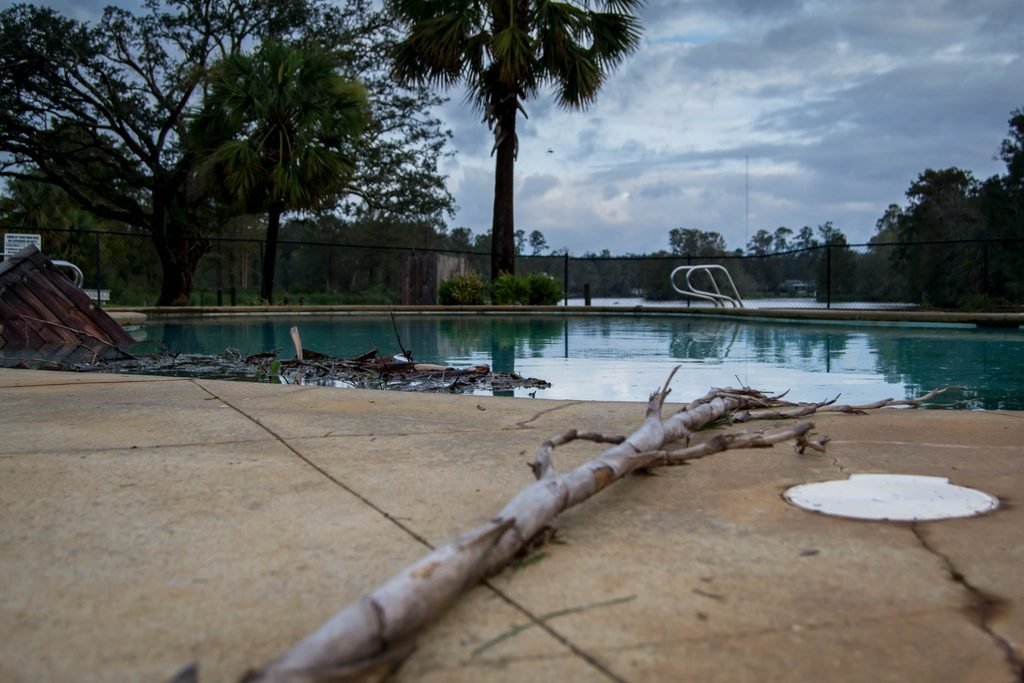
Debris impact. Flying debris — branches, patio furniture, screen panels, roof tiles — can chip or crack pool surfaces, crack tile lines, or damage equipment. A direct impact on a return jet, skimmer, or light niche can create a leak that wasn’t there before the storm.
Equipment stress. Heavy rain, flooding around the equipment pad, and power surges all put stress on pool pumps, filters, and plumbing connections. Equipment that was already showing its age may not survive the strain.
Pre-existing leaks exposed. Sometimes the hurricane doesn’t cause the leak — it just makes it undeniable. A slow seep you’d been ignoring becomes obviously wrong after a storm adds several inches of rain to your pool and then the level still drops faster than it should.
Step One: Do a Visual Walkthrough Before Touching Anything
Before you turn the equipment back on, do a full visual pass around the pool. You’re looking for anything that looks wrong, cracked, out of place, or wet when it shouldn’t be.
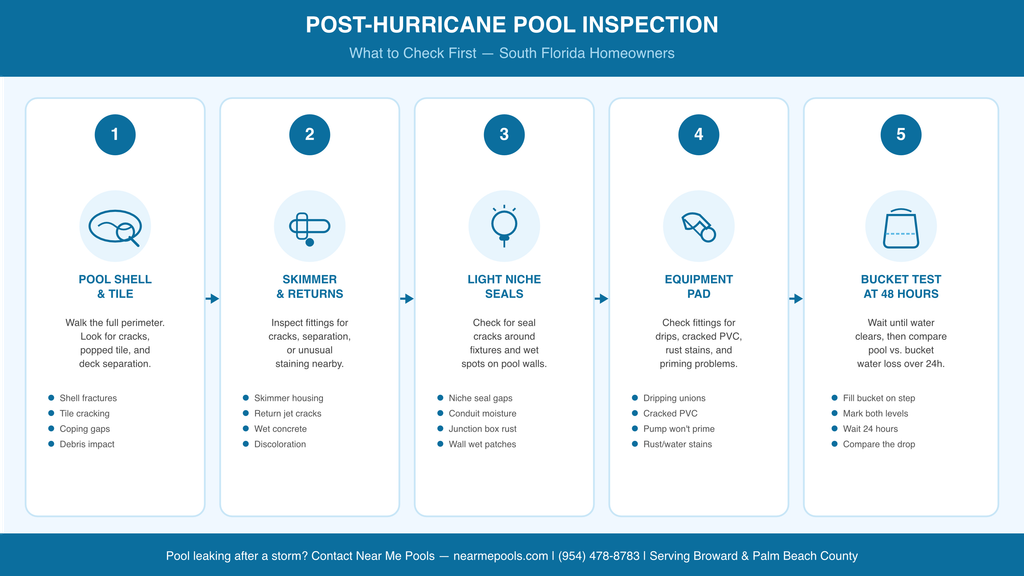
Check the Pool Shell and Waterline Tile
Walk the entire perimeter. Look for:
- New cracks or fractures in the pool shell — especially along the steps, near fittings, or at the waterline
- Tile that has popped off or cracked (tile cracking along the waterline is sometimes an early indicator of shell movement)
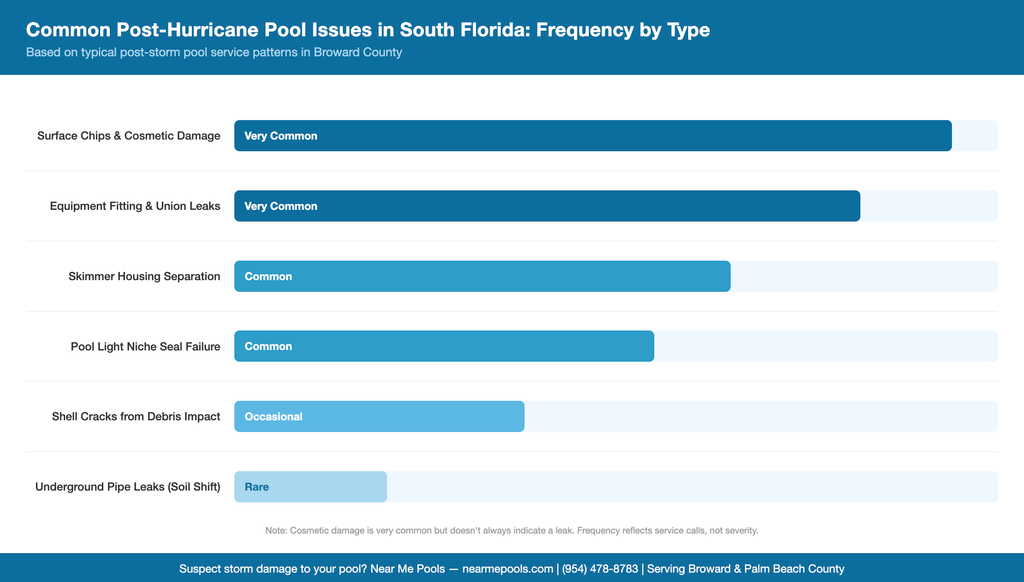
- Surface chips or gouges from debris impact
- Any visible separation between the deck and the coping (the edge lip around the pool)
Small surface chips from debris impact don’t necessarily mean you have a leak. But cracks — especially ones that run through fittings, return jets, or the pool light housing — are worth taking seriously.
Inspect the Skimmer and Return Jets
Storm debris can lodge inside skimmers and return jets, but more importantly, check around them:
- Is there visible separation between the skimmer housing and the pool wall?
- Do the return jet fittings look intact, or are any cracked or dislodged?
- Is there discoloration, staining, or unusual wet concrete around the skimmer box?
Skimmers are one of the most common leak points in any pool — and they’re also one of the most vulnerable to ground movement after a major storm.
Look at the Light Niches
Pool light fixtures sit inside a niche that’s sealed into the pool shell. That seal is a common leak point even under normal conditions. After a storm — especially if there was significant ground movement or debris impact — the seal around a light niche can crack or separate.
The telltale sign: water that tracks along the conduit pipe behind the light fixture, often showing up as a wet patch on the outside of the pool wall or as moisture near the junction box on the equipment pad.
Step Two: Inspect the Equipment Pad Carefully
This is where a lot of post-storm damage hides. Walk the equipment pad with fresh eyes and look for:
- Dripping fittings or unions — The PVC unions that connect your pump and filter can loosen during flooding or equipment movement. Even minor loosening can produce a steady drip.
- Cracked PVC pipe sections — Visible cracks in the plumbing above ground, especially at joints or 90-degree elbows, are common after storms.
- Equipment that won’t prime — If your pump is struggling to prime after being restored, it may be pulling air from a cracked suction line.
- Rust streaks or water stains — Staining that wasn’t there before suggests water has been escaping somewhere nearby for hours or longer.
- Flooded conduit or electrical connections — If the equipment area was underwater during the storm, have a licensed electrician or pool tech verify that all electrical connections are safe before running equipment.
Important: Don’t force a pump to run if it’s struggling to prime. Running a pool pump dry — even for a few minutes — can damage the seals and impeller. If it won’t prime after a reasonable attempt, shut it down and call a professional.
Step Three: Check the Water Level — But Interpret It Carefully
After a hurricane, your pool likely gained a significant amount of water from rainfall. So if your water level is lower than expected right after the storm, that’s a red flag. It means the pool lost water faster than the rain added it — which points strongly toward a leak.
If the water level looks normal or high, don’t assume you’re in the clear. Wait 24–48 hours after the storm and then do the bucket test.
The Bucket Test After a Hurricane
The bucket test is the standard method for separating evaporation from an actual leak — and it works just as well in post-storm conditions:
- Fill a 5-gallon bucket with pool water and set it on a pool step (submerged a few inches)
- Mark the water level inside the bucket with a piece of tape
- Mark the pool water level on the exterior of the bucket (or on the pool wall)
- Wait 24 hours
- If the pool lost significantly more water than the bucket, you likely have a leak
A small note for post-storm conditions: if your pool still has active debris or the water is unusually turbid (murky), wait until it clears enough to see the markings clearly before starting the test. Trying to read water levels through cloudy water gives you unreliable results.
What You Cannot Check Yourself
Visual inspections catch a lot — but they don’t catch everything. Underground plumbing leaks, for example, leave no visible trace above ground. Neither does a leak inside a conduit or behind a pool light fixture that’s seeping water slowly along its run.
If your bucket test comes back positive — or if you notice obvious physical damage to the shell or equipment — the next step is professional leak detection. Methods like pressure testing and electronic acoustic detection can pinpoint exactly which line or fitting is losing water without guessing, digging randomly, or running up unnecessary repair costs.
This is particularly important after a storm because you may have multiple issues happening at once — a loose fitting and a small shell crack, for example — and only isolating each one precisely will tell you what actually needs to be repaired.
When to Call a Professional
Call a professional leak detection service if any of these are true:
- Your bucket test shows more loss from the pool than from the bucket — confirmed leak, time to locate it
- You see visible cracks in the shell, especially near fittings, jets, or the light niche
- The equipment pad has active dripping from connections, pipe sections, or fittings that you can’t tighten and stop
- The pump won’t prime after a couple of attempts — likely a suction-side air leak
- The water level is visibly lower than it was before the storm despite significant rainfall
- You see wet patches in the yard or soil erosion around the pool that wasn’t there before
Don’t wait weeks to investigate. A post-hurricane leak that goes unaddressed can erode the soil under your pool deck, accelerate surface degradation, and allow water to migrate toward your home’s foundation. The longer you wait, the more potential for the problem to compound.
A Note on Timing: Don’t Rush the Repairs
South Florida homeowners often want to fix everything immediately after a storm — understandably. But pool shell repairs in particular benefit from waiting until the ground fully stabilizes and dries out. Repairs done too quickly, while the soil is still heavily saturated, may not bond or cure properly.
Your professional leak detection service can advise you on timing. In many cases, detecting the leak and understanding its scope is the right immediate step — actual repairs can be scheduled once conditions are stable.
Summary
Hurricanes put real stress on South Florida pools. Ground movement, debris impact, and flooding can crack shells, loosen fittings, and damage underground plumbing — sometimes obviously, sometimes in ways you won’t see without the right equipment. Your job after the storm is to do a thorough visual pass, let conditions stabilize, perform the bucket test, and pay attention to what your pool and equipment are telling you. If the bucket confirms a leak, or if you spot obvious physical damage, professional detection is the fastest and most cost-effective path to an answer.
Is Your Pool Leaking After the Storm?
If you’re in Broward County or Palm Beach County and you suspect storm damage to your pool, the team at Near Me Pools is ready to help. We’ll perform a full pool leak detection inspection — visual, pressure testing, and electronic detection if needed — and give you a clear picture of what’s happening and what comes next.
Reach out to our team: call us at (954) 478-8783, or email us at contact@nearmepools.com. We know South Florida pools, and we know what storms do to them.
Frequently Asked Questions
How do I know if my pool lost water from the hurricane or from a leak?
The easiest way to start is with the bucket test — fill a bucket with pool water, mark both water levels, and compare them after 24 hours. If the pool drops significantly more than the bucket, you have a leak. This test works after a hurricane as long as the water has settled and is clear enough to read the markings accurately. You can also read more about pool evaporation vs. leak detection on our site.
My pool equipment was flooded during the storm. Is it safe to turn back on?
Not necessarily. If your pump, filter, or heater was fully submerged, have a professional inspect it before running. At minimum, wait until the equipment pad is fully dry and check all electrical connections. Running a pump that’s still partially flooded or that was damaged internally can cause further damage or create a safety hazard.
How long after a hurricane should I wait before getting a leak detection inspection?
Ideally, wait until the immediate post-storm period has passed — typically 48–72 hours — to let water levels settle and debris clear. That said, if you see obvious shell damage or active dripping at the equipment pad, don’t wait. Call us and we’ll assess the situation.
Can a hurricane cause underground pool pipe leaks?
Yes. Significant soil movement from ground saturation can stress underground plumbing enough to cause cracks or joint failures. These leaks often show no visible signs above ground, which is why pressure testing is often the best post-storm diagnostic tool when other inspections come back inconclusive.
My water level looks fine but the equipment is acting strange. Could I still have a leak?
Yes — equipment issues and leaks don’t always show up the same way. A struggling pump that won’t fully prime can indicate an air leak on the suction side. Unusual sounds or pressure drops can also signal a plumbing issue. If your equipment behavior changed after the storm, it’s worth having a professional take a look even if the water level seems stable.