

The pool is finally getting renovated — and then someone asks, “So what are you doing with the deck?”
Suddenly a project that felt defined gets a lot bigger. Because the deck isn’t just a frame around the water. It’s the surface your family walks on barefoot in July. It’s the first thing guests see when they step outside. It sets the tone for the entire backyard — and in South Florida, it takes a beating unlike almost anywhere else in the country.
Blistering heat, year-round UV exposure, afternoon thunderstorms, and daily pool traffic mean the deck material you choose has to do real work. What looks great on a showroom board needs to actually perform under Florida conditions. If you’re planning a pool deck renovation and trying to sort out your options, this guide walks through every major material — what each one is, where it shines, and where it falls short.
Why the Deck Decision Matters More in South Florida
Most of the country treats pool decks as a summer-only concern. In South Florida, the deck is in play every single month of the year. That changes the durability math considerably.
A few factors are specific to this region:
Heat and UV. South Florida averages over 250 sunny days per year, and the UV index regularly hits extreme levels during summer months. Dark surfaces absorb heat and become uncomfortable underfoot — sometimes dangerously so. Heat retention is a real material selection factor here, not a minor footnote.
Rain cycles. Afternoon rainstorms are a near-daily event from May through October. Any deck material needs to handle rapid wet/dry cycles without heaving, cracking, or becoming dangerously slippery when wet.
Year-round pool use. With no off-season, the deck sees more foot traffic annually than virtually any northern climate. Durability and ease of maintenance over time matter more than they would for a pool used six months a year.
Property values and aesthetics. South Florida’s real estate market is competitive, and outdoor living space carries real weight with buyers. A dated or worn pool deck can undercut an otherwise well-maintained property.
The Five Main Pool Deck Materials
1. Travertine
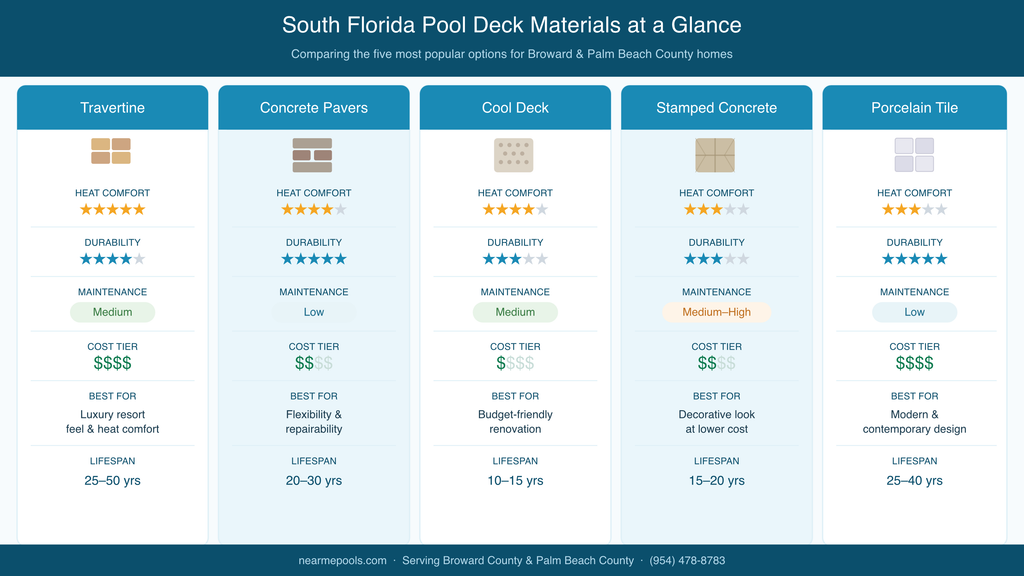
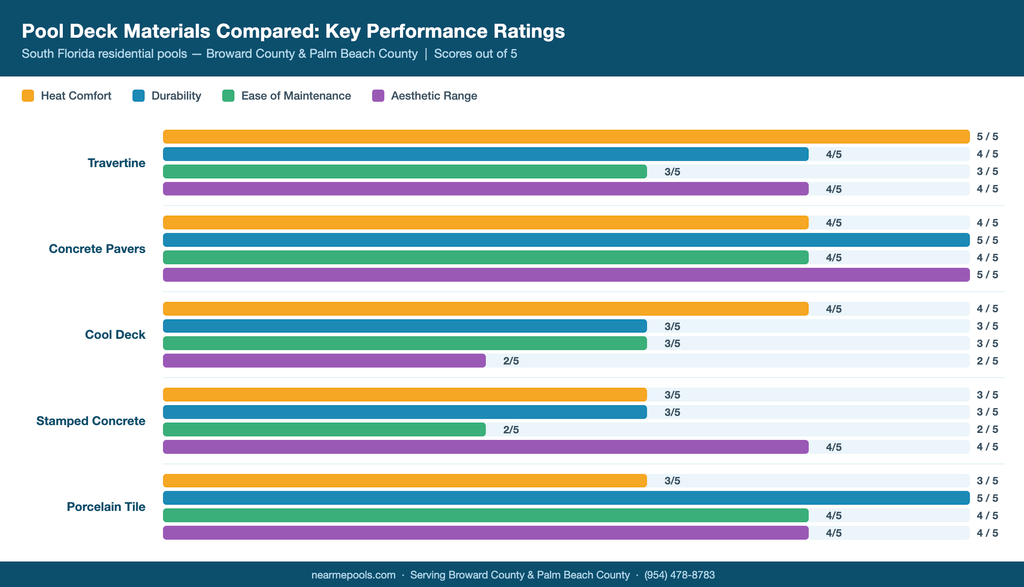
Travertine is a natural limestone that’s become one of the most popular pool deck materials in South Florida luxury homes — and for good reason. Its natural porous surface stays notably cooler underfoot than most alternatives, even in direct sun. That alone makes it a top contender in this climate.
Beyond comfort, travertine has an unmistakably premium aesthetic. The natural variation in color and texture — creamy whites, warm golds, subtle grays — complements the tropical landscaping and architecture common in Broward and Palm Beach County homes. It photographs beautifully and holds its appeal over time.
What to know before choosing it: Travertine is a natural stone, and it needs proper sealing and maintenance to stay looking its best. Pool chemicals, sun exposure, and the Florida climate will eventually wear an unsealed travertine surface. You’ll also want to ensure the installation is done correctly — natural stone is less forgiving of poor subgrade preparation than poured surfaces, and movement or settling can cause cracking or unevenness over time.
It’s typically among the higher-cost deck options, and that cost reflects both the material and the skill required to install it well. But for homeowners going for a true luxury finish, travertine is difficult to beat.
2. Concrete Pavers
Concrete pavers — sometimes called patio pavers or pool pavers — are one of the most versatile and widely used pool deck options in South Florida. They come in an enormous range of sizes, shapes, colors, and finishes, and they can be arranged in patterns that mimic natural stone, brick, or contemporary geometric designs.
One of the most practical advantages of pavers: individual units can be replaced. Unlike a poured surface, if one section shifts, cracks, or stains, you can lift and replace specific pavers without resurfacing the entire deck. For homeowners who value long-term repairability, that’s a meaningful consideration.
Concrete pavers also handle South Florida’s freeze-thaw concerns well — though since we don’t have freeze cycles to worry about here, the bigger benefit is their drainage performance. Joint spacing between pavers allows water to move through rather than pool on the surface.
What to know before choosing them: The quality of concrete pavers varies significantly. Thinner units or lower-density pavers can chip or fade faster under high UV exposure. Weeds and insects can sometimes work into the joints over time if the base isn’t properly prepared. The installation base — compaction, bedding sand, edging restraints — matters as much as the pavers themselves.
Pricing varies by paver type, with basic concrete pavers being among the more affordable deck options and premium large-format pavers approaching the cost of natural stone.
3. Cool Deck (Kool Deck)
Cool Deck is a trademarked finish that’s been a South Florida staple for decades, and there’s a reason it became so ubiquitous: it works. It’s a cementitious textured coating applied over an existing concrete surface that reflects heat rather than absorbing it, keeping the surface temperature noticeably cooler than bare concrete even in midday Florida sun.
The texture is also inherently slip-resistant, which matters around pool edges where wet feet are the rule, not the exception.
If you’re renovating an existing pool deck that’s structurally sound but worn in appearance, Cool Deck can often be applied as a resurfacing treatment over the existing concrete — which significantly reduces the scope of work and the overall cost compared to removing and replacing the existing deck.
What to know before choosing it: Cool Deck is not a premium aesthetic — it has a distinctive textured look that reads as classic Florida rather than luxury resort. That’s not a knock; it fits many homes perfectly. But if you’re going for a high-end travertine or contemporary tile look, Cool Deck won’t get you there.
It does require maintenance over time. The surface can chip, fade, or develop hairline cracks, and it will eventually need recoating. That said, for homeowners who want a functional, heat-conscious, budget-friendly deck option, Cool Deck is hard to argue with.
4. Stamped Concrete
Stamped concrete occupies an interesting middle ground — it’s poured concrete that’s been textured and colored to mimic the look of natural stone, pavers, brick, or wood. Done well, it can look convincingly like premium materials at a significantly lower price point. Done poorly, it can look exactly like what it is: colored and stamped concrete.
In South Florida, stamped concrete is often chosen by homeowners who want the visual appeal of travertine or stone without the material cost. It can produce genuinely attractive results in the right hands, and the color and pattern options are nearly unlimited.
What to know before choosing it: Stamped concrete has two meaningful limitations in Florida conditions. First, it requires sealing — and that sealer degrades faster under high UV than it would in cooler climates. Plan on resealing every two to three years to protect the color and surface from fading and moisture penetration. Second, unlike pavers, stamped concrete is a monolithic surface — if it cracks (and it will eventually), you can’t pull out a section and replace it. Repairs are visible. For larger pool decks, this is worth thinking through carefully before committing.
5. Porcelain Tile
Porcelain tile has become increasingly popular in contemporary South Florida pool designs, particularly in higher-end renovations going for a sleek, modern aesthetic. Large-format porcelain tiles — often 24×24 inches or larger — create an expansive, seamless look that complements modern architectural styles beautifully.
Porcelain is highly durable, resistant to staining, frost-proof (not that it matters here), and available in finishes that replicate natural stone, concrete, or wood with impressive realism. It’s also non-absorbent, which means it won’t stain from pool chemicals the way natural stone can.
What to know before choosing it: The two main considerations with porcelain are surface finish and cost. Not all porcelain tiles are rated for outdoor and wet area use. The tile must have the appropriate slip resistance rating for a pool deck environment — this is a specification your contractor should confirm, not assume. Glossy finishes are often not appropriate. Second, large-format porcelain installation is skilled work. The substrate needs to be perfectly prepared, and grouting large tiles requires experience to avoid lippage or joint inconsistencies.
Cost is typically in the upper range, similar to travertine and premium pavers. But for the right contemporary pool design, it’s a material that delivers a genuinely high-end result.
How to Actually Choose
Once you understand what each material is, the harder question is which one is right for your specific situation. A few questions to work through:
What’s the condition of your existing deck? If you have a structurally sound concrete deck in good condition, Cool Deck resurfacing or a stamped concrete overlay may be a practical option. If the existing deck is significantly deteriorated — cracked, heaving, or detaching — you’re likely looking at full removal and replacement, which opens up all the options.
What’s the aesthetic direction of your pool and home? Travertine and pavers suit warm, tropical, or Mediterranean-style homes. Large-format porcelain reads as contemporary and architectural. Cool Deck is classic and utilitarian. Stamped concrete can go either direction depending on the pattern. Think about what you’re building toward, not just what looks good in isolation.
How much does heat comfort matter? If you have young kids running back and forth to the pool, or if you spend significant time walking the deck during midday sun, heat retention matters. Travertine and lighter-colored pavers are the standout performers here. Dark-toned materials in any category will absorb more heat.
How long are you planning to stay in the home? If you’re renovating with a potential sale in mind within a few years, the investment calculus is different than if this is your forever home. High-end travertine or porcelain may deliver better return in a sale context; Cool Deck or stamped concrete may be the more practical choice for a shorter hold period.
Are you renovating the pool at the same time? If you’re already resurfacing the pool interior, replacing tile, or adding water features, incorporating the deck into that same project often makes financial and logistical sense. Work done simultaneously avoids the disruption of coming back to the deck later — and contractors can often provide better pricing when the scope includes multiple elements.
What the Process Looks Like
Regardless of material, a pool deck renovation in South Florida follows a general sequence. Understanding what’s involved sets realistic expectations before you start.
Evaluation and planning. A contractor will assess the existing deck — its structural condition, substrate, drainage, and how it integrates with the pool shell and coping. This evaluation shapes what’s feasible within your scope and budget.
Permits. Most pool deck renovations in Broward County and Palm Beach County require permits, especially when work involves the pool shell, plumbing, or structural elements. A responsible contractor will identify permit requirements upfront. Always ask — it’s not optional.
Demolition and prep. Depending on the scope, this may involve removing the existing deck surface, leveling and compacting the base, and addressing any drainage or structural issues before anything goes down.
Installation. This is the most variable phase in terms of timeline, depending on material — pavers and travertine can go down relatively quickly once the base is prepared; poured and stamped concrete requires curing time; large-format porcelain requires precise installation. Your contractor will give you a realistic timeline based on the specific scope.
Curing, sealing, and finishing. Some materials require sealing before the pool can be refilled and used. There may be a brief period of limited deck access while coatings or adhesives cure. Your contractor will walk you through what to expect here.
For a typical pool deck renovation — not a full pool remodel — downtime is usually measured in days to a few weeks, not months. The specific timeline depends on the size of the deck, the material chosen, and whether any additional work is being done simultaneously.
What You Now Know
Choosing a pool deck material in South Florida isn’t just an aesthetic decision — it’s a practical one shaped by heat, weather, pool use patterns, and how long you plan to enjoy the space. Travertine delivers unmatched natural beauty and heat comfort. Concrete pavers offer flexibility and repairability. Cool Deck is a proven, budget-conscious option for functional renovations. Stamped concrete can deliver premium looks at a lower price when installed well. Porcelain tile is the choice for contemporary designs that demand a clean, modern finish.
The right answer depends on your home, your lifestyle, and your vision for the backyard. The best starting point is a thorough evaluation of your existing deck and a conversation with a licensed pool renovation contractor who can tell you what’s actually possible given what you’re working with.
Thinking Through Your Deck Options?
If you’re in the planning stages and trying to figure out where to start — or just want a second opinion on what your existing deck might actually need — feel free to reach out. Near Me Pools serves Broward County and parts of Palm Beach County, and we’re happy to talk through what’s involved even if you’re just in research mode.
Get in touch with our team, give us a call at (954) 478-8783, or email us at contact@nearmepools.com. No agenda — just a straight conversation.
You can also explore the full range of pool services we offer across South Florida, or learn more about our team and the work we do.
Frequently Asked Questions
What is the best pool deck material for South Florida heat?
Travertine consistently ranks at the top for heat comfort — its natural porous structure reflects rather than absorbs heat, keeping the surface noticeably cooler underfoot even in direct midday sun. Light-colored concrete pavers are a close second. Dark-toned materials in any category will retain more heat, so color matters almost as much as material type.
How long does a pool deck renovation take in Broward County?
Timeline varies by scope and material. A Cool Deck resurfacing can often be completed in a few days. A full deck replacement with natural stone or pavers typically runs one to three weeks, depending on deck size and whether concurrent pool work is being done. Permits are required for most renovations, so factor in permit processing time when planning your project start date.
Can you resurface a pool deck without replacing it?
In many cases, yes — if the existing concrete substrate is structurally sound and not significantly heaved or cracked, Cool Deck, stamped concrete overlays, or certain tile installations can go over the existing surface. A contractor will evaluate the existing deck before recommending a resurfacing approach versus full replacement.
What’s the difference between pavers and travertine for a pool deck?
Pavers are manufactured from concrete in controlled shapes and densities. Travertine is a natural limestone quarried stone. Both are excellent pool deck materials in South Florida, but they’re different in appearance, cost, and care. Travertine has a natural, organic beauty that concrete pavers can approximate but not fully replicate. Concrete pavers are generally more uniform, easier to source, and more repairable at the individual unit level. Which is right depends on your aesthetic goals and budget.
Do pool decks in South Florida require permits?
Most pool deck renovations — especially those involving structural changes, new drainage, or modifications that connect to the pool shell — require permits in Broward County and Palm Beach County. Always confirm permit requirements with your contractor before work begins. A contractor who doesn’t pull permits is a red flag, not a convenience.
How often does a pool deck need to be resealed or maintained?
It depends on the material. Travertine and natural stone should be sealed at installation and resealed every one to three years depending on exposure. Stamped concrete typically needs resealing every two to three years in Florida’s UV environment. Concrete pavers may need joint sand replenishment and occasional sealing. Porcelain tile generally requires the least maintenance once properly installed. Regular pool cleaning and maintenance by a knowledgeable pro includes a periodic eye on the deck as well — often the first person to notice early deck issues is the person maintaining the pool week to week.
Near Me Pools serves residential and commercial pools across Broward County and parts of Palm Beach County. View our service area.