

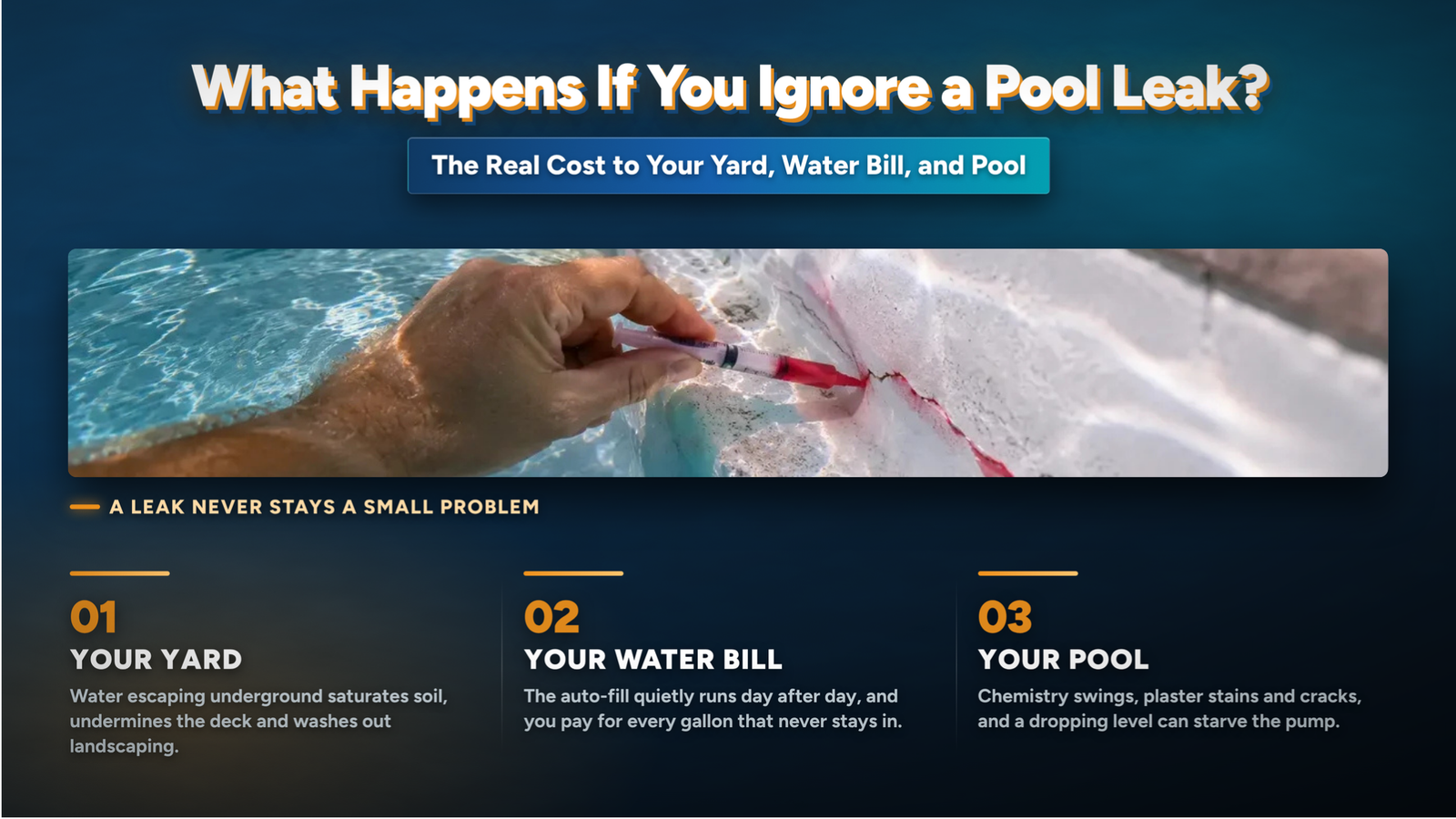
You noticed the water level was low last week. You topped it off, told yourself it was probably evaporation, and moved on. Then you topped it off again three days later. And again over the weekend.
At some point, “probably evaporation” stops being a reasonable explanation — and a pool leak starts being the more honest answer.
Here’s the thing: most pool leaks don’t announce themselves. They’re quiet, slow, and easy to rationalize away. But they’re also compounding. Every day you wait, the costs — financial and structural — stack up in ways that aren’t always obvious until the damage is done.
The Problem With “Waiting to See”
Plenty of homeowners know something seems off with their pool but hold off on doing anything. Maybe it doesn’t feel urgent. Maybe you’re hoping it resolves on its own (it won’t). Maybe you just don’t want to deal with it right now.
That hesitation is understandable. But a pool that’s losing water continuously — even just an inch or two per week — is actively causing damage every single day. The cumulative impact of an undiagnosed, unfixed pool leak can turn a simple repair into a major project.
Here’s what’s actually happening while you wait…
Your Water Bill Is Climbing — And You’re Paying for It Twice
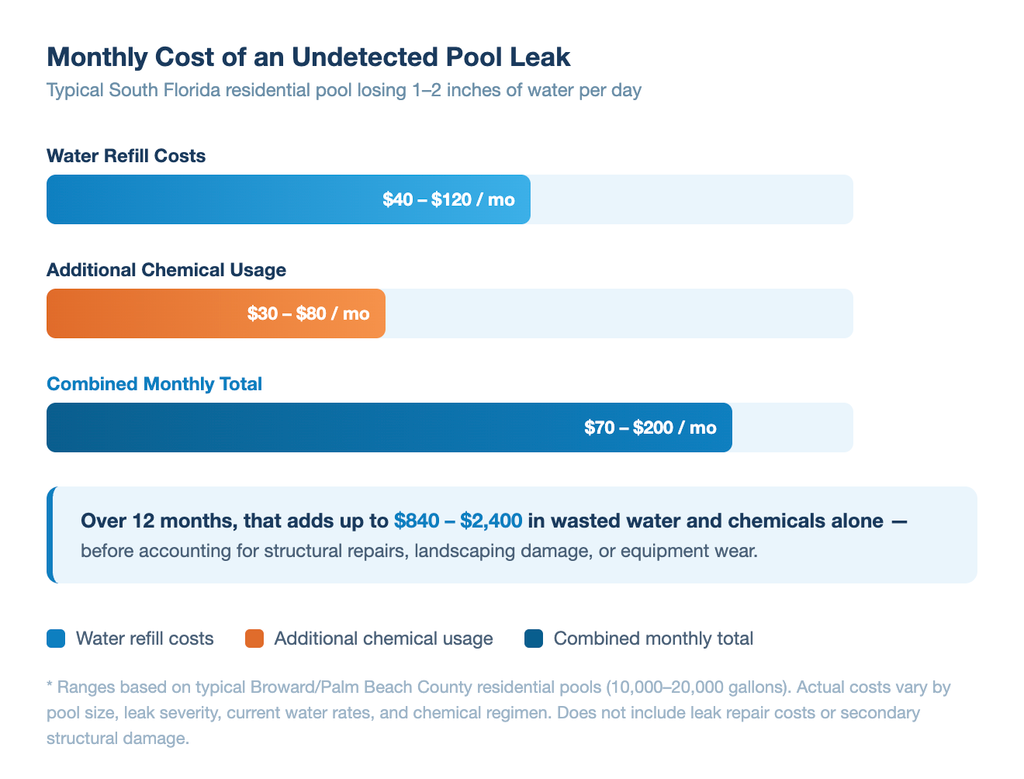
A pool losing one inch of water per day sounds minor. It isn’t. Depending on pool size, that can add up to 10,000 to 25,000 gallons of water lost per month — water you’re paying for every time you top the pool off.
In South Florida, where year-round pool use means you’re maintaining water levels twelve months a year, that math gets painful fast. A slow leak can quietly add hundreds of dollars to your annual water bill without any single month looking dramatic enough to trigger alarm.
And here’s the part that stings twice: when you add fresh water to replace what’s lost, you’re also diluting the chemicals you paid for. Your pool’s carefully balanced chlorine, alkalinity, and pH levels get thrown off every time you top off. That means more chemicals to rebalance — on top of the water costs themselves.
What a Constant Leak Does to Your Yard and Landscaping
The water has to go somewhere. When a pool is leaking, that water is seeping into the soil beneath and around your pool — often concentrating in one area depending on where the leak is located.
Over weeks and months, that constant moisture saturation does real damage to your yard:
- Grass and landscaping die off in the saturated zone, while surrounding areas may show uneven growth
- Soil erosion begins to undermine the stability of your pool deck and surrounding hardscape
- Sinkholes and soft spots can develop in the grass near the pool or pool equipment pad — a serious trip hazard, and a red flag that something structural is happening underground
- Root damage and mold growth can affect nearby trees, shrubs, and any organic mulch near the wet zone
South Florida soil, particularly in parts of Broward and Palm Beach counties, is already prone to certain types of shifting — especially in areas with sandy or fill soil. A sustained underground water source accelerates that movement. What starts as a soft patch of grass can quietly become a real structural issue for your deck or pool surround.
The Structural Damage That Builds Up Over Time
This is the part most homeowners don’t think about until it’s too expensive to ignore.
Pool Deck and Coping
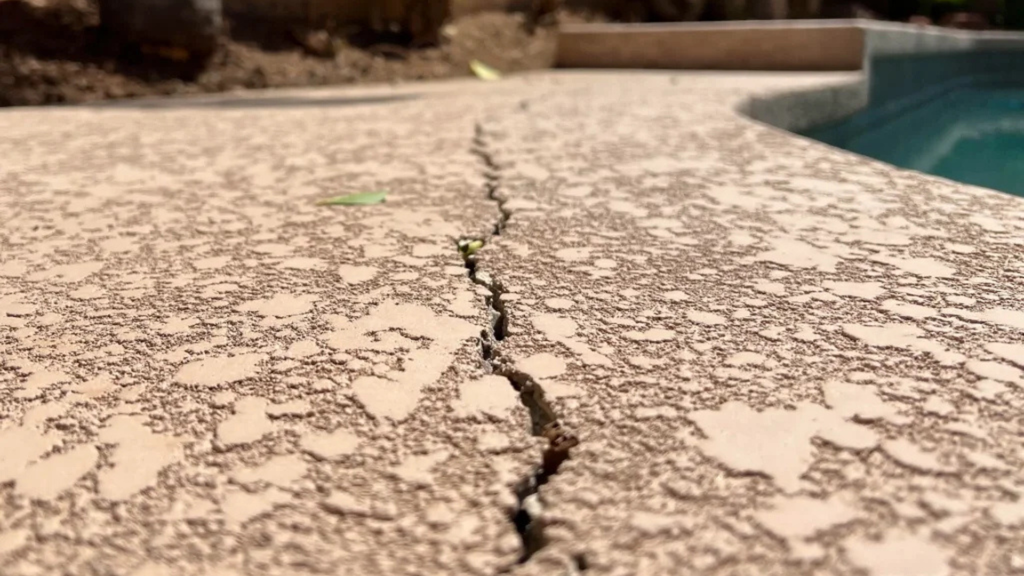
Water continuously saturating the ground beneath your deck will eventually compromise the sub-base that holds it in place. Concrete decks can crack, shift, and heave as the soil beneath them swells and contracts with moisture changes. Pavers can sink and become uneven. Coping — the finished edge cap at the pool waterline — can lift, separate, and crack, letting even more water in and creating a cycle that accelerates the damage.
Deck repairs and coping replacement are not inexpensive. A problem that could have been caught early with a straightforward leak detection inspection can turn into a full deck re-pour or re-lay if it’s left long enough.
Pool Shell and Plumbing
Pool plumbing runs underground. When a pressurized line is leaking, that water is eroding the soil around the pipe — and in some cases, causing the pipe to shift or sink further. The longer this goes unaddressed, the more material is washed away from around the line, and the harder (and more costly) it becomes to access and repair.
Pool shells — whether plaster, quartz, or pebble aggregate — can also show accelerated surface wear in areas of persistent water chemistry imbalance caused by constant dilution. Staining, etching, and soft spots in the plaster can become more than cosmetic issues over time.
The Chemical Waste You May Not Be Tracking
Most pool owners think about leaks in terms of water loss. Fewer think about the chemical cost.
Every gallon of pool water that escapes through a leak takes with it the chemicals you paid to add. Chlorine, stabilizer, alkalinity adjusters, algaecides — all of it goes out with the water. When you top off, you’re adding back fresh water that has zero chemistry, which throws off every parameter you’ve been managing.
In South Florida’s heat, where chlorine burns off faster than almost anywhere else in the country, that imbalance creates a real algae risk. A pool that’s constantly being diluted and rebalanced is a pool that’s working hard just to stay even — and one that’s more likely to go green during a stretch of hot weather when you least want to deal with it.
How to Know If You Actually Have a Leak
Before assuming the worst, there’s one test worth doing yourself: the bucket test. It’s the standard method for distinguishing between normal evaporation and a real leak, and it costs nothing.
Here’s the short version:
- Fill a bucket with pool water and place it on a step in the pool (so it’s at the same temperature)
- Mark the water level inside the bucket and the pool water level on the outside of the bucket
- Leave it alone for 24 hours (no swimming, no auto-fill running)
- Compare the two levels
If the pool lost significantly more water than the bucket, you likely have a leak. If they dropped the same amount, what you’re seeing is probably normal evaporation — especially during South Florida summers, when you can lose a quarter to half an inch per day to heat alone.
If your bucket test points to a leak, that confirmation is useful. What it won’t tell you is where the leak is — and that’s where professional detection becomes essential.
When to Stop Waiting and Call a Professional
If your bucket test confirms a leak, the right move is to call a pool leak detection professional — not to keep investigating on your own.
Here’s why: leak detection is a diagnostic specialty. Finding the actual source of a leak requires pressure testing individual plumbing lines, dye testing around fittings and light niches, and in some cases using acoustic equipment to pinpoint underground leaks without unnecessary excavation. These aren’t tasks with DIY workarounds — the value of professional detection is that it gives you a precise answer instead of an expensive guess.
Homeowners who skip professional detection and try to diagnose and fix a suspected leak themselves often end up doing unnecessary work — digging in the wrong place, patching the wrong fitting, or missing a slow underground line leak entirely. Meanwhile, the actual leak keeps going.
The sooner you get a professional out, the smaller the repair bill is likely to be — not just for the leak itself, but for the secondary damage that compounds with every week of delay.
The Bottom Line
A pool leak won’t fix itself. It won’t slow down because you’re ignoring it. What it will do is cost you money on your water bill, waste the chemicals you’re buying, erode the soil under your deck, and potentially turn a routine repair into a structural headache.
The good news is that most leaks — when caught early — are diagnosable and fixable without major disruption. The bucket test gives you a clear starting point. If it points to a real leak, professional detection from a qualified team can usually pinpoint the source efficiently and give you a clear path forward.
Ready to Find Out What’s Going On?
If your pool is losing water and you’re past the point of wondering, the team at Near Me Pools serves Broward County and parts of Palm Beach County with professional leak detection services. We can diagnose what’s happening and tell you exactly what needs to be done — no guessing, no unnecessary work.
Reach out to our team, give us a call at (954) 478-8783, or email us at contact@nearmepools.com — we’re happy to take a look and give you a straight answer.
Frequently Asked Questions
How much water is normal for a pool to lose per day in South Florida?
Evaporation in South Florida can account for roughly ¼ to ½ inch of water loss per day during hot months — and up to ¾ inch on very hot, low-humidity days. Anything consistently beyond that range, especially when you’re losing water overnight when evaporation slows, is worth investigating with a bucket test. Visit our pool leak detection page to learn more about what we look for.
Can a pool leak cause foundation damage to my home?
A pool leak directly adjacent to your home’s foundation is worth taking seriously, but it’s not an automatic disaster. The more immediate risk is usually to the pool deck, coping, and surrounding landscaping — the areas closest to the continuous water source. If you’ve noticed wet spots near your home’s foundation or signs of soil movement near the house, mention that when you contact a professional.
What happens if I just keep topping off my pool without fixing the leak?
You can maintain water level indefinitely by topping off, but you’re essentially paying to send water into the ground — and paying again to re-add chemicals every time you dilute them. More importantly, the structural damage (soil erosion, deck movement, plumbing wear) continues accumulating even if the water level looks fine.
How long does a professional pool leak detection inspection take?
Most inspections take a few hours, depending on the size of the pool, the number of plumbing lines, and the complexity of the suspected leak. Pressure testing each line and performing dye testing around common leak points takes time to do right. We’ll walk you through what’s involved when you contact us.
Does a pool leak always show visible signs?
Not always — especially with underground plumbing leaks. Above-ground leaks (around fittings, light niches, skimmers, or return jets) often leave visible wet spots, staining, or dripping. Underground leaks can go months without any visible surface evidence other than water loss. That’s precisely why professional detection using pressure testing and acoustic equipment exists.
Will my homeowner’s insurance cover a pool leak?
Coverage varies widely by policy. Some homeowner’s insurance policies cover sudden, accidental water damage but exclude gradual leaks that went unaddressed over time. It’s worth contacting your insurance provider directly — and having documentation of when you discovered the issue can help your case.