

You’ve done the bucket test. The pool dropped more water than the bucket — so yes, there’s a real leak somewhere. Now what?
For a lot of homeowners, that’s where the frustration starts. Knowing you have a leak is one thing. Knowing where it is turns out to be a completely different problem. Pool leaks can originate at a handful of specific points, and they rarely announce themselves obviously. Some drip visibly. Most don’t.
Understanding where leaks most commonly start is genuinely useful — even if you’re planning to call a professional. It helps you describe what you’re seeing, rule out some areas on your own, and know what to expect from a pool leak detection inspection.
Why Location Matters So Much
Not all pool leaks are equal — and the location of a leak determines almost everything: how it’s found, how it’s fixed, how long the repair takes, and how much damage it can cause if left alone.
A dripping fitting at the equipment pad is a very different problem than a hairline crack in an underground return line. A leaking light niche is found differently than a failing skimmer throat. Diagnosing a pool leak accurately requires knowing which areas to investigate and in what order — which is why professional leak detection follows a systematic process rather than guessing.
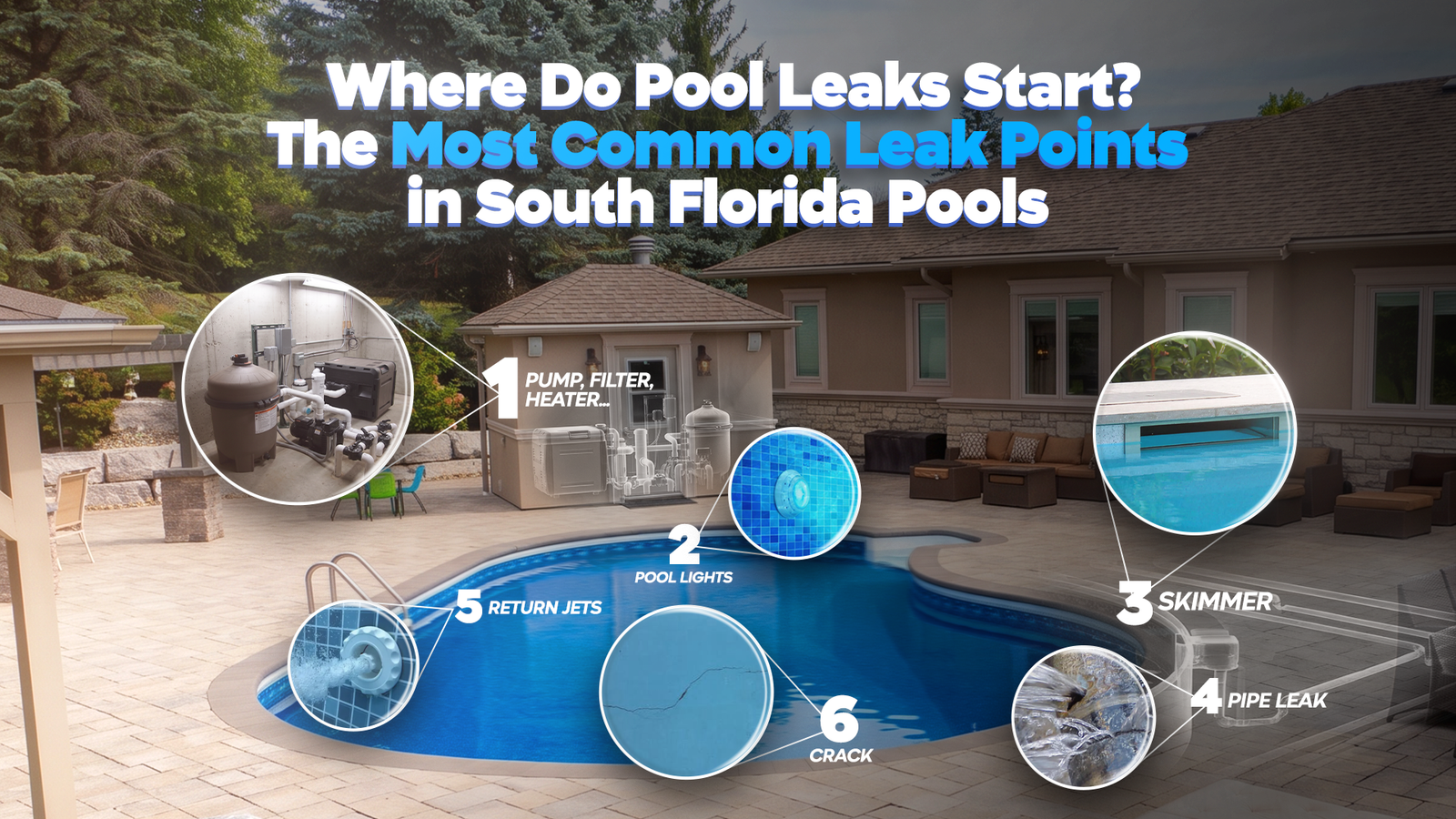
Here’s a breakdown of the most common leak points in residential pools, especially relevant to South Florida conditions.
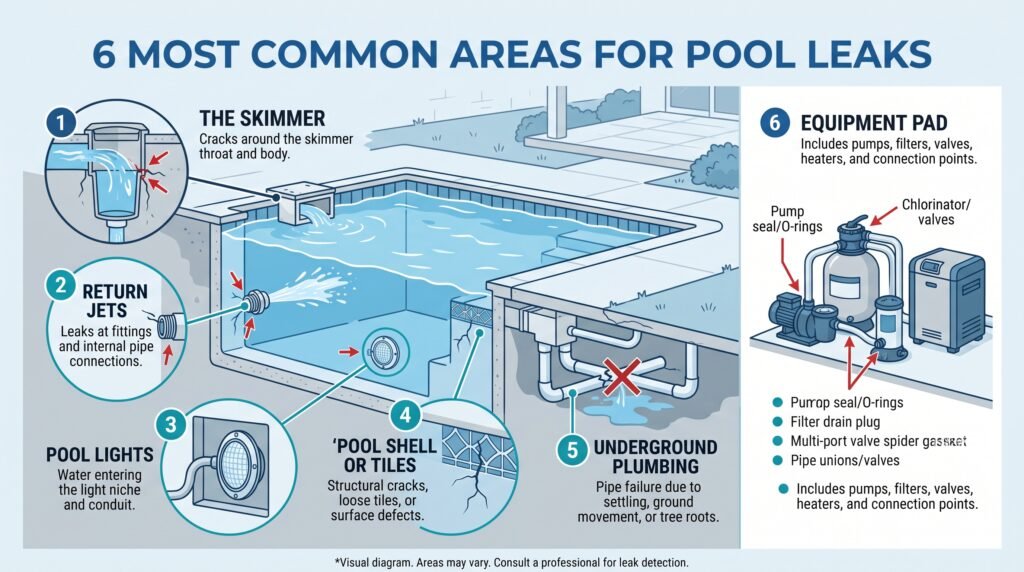
1. The Skimmer — The Single Most Common Culprit
If there’s one place that accounts for more pool leaks than anywhere else, it’s the skimmer. The skimmer is the rectangular opening built into the pool wall that draws surface water into the filtration system. It’s under constant hydraulic stress, and it sits at the waterline — exactly where thermal expansion, ground movement, and water chemistry fluctuations do the most wear.
What Goes Wrong
The most common failure point is the bond between the plastic skimmer body and the pool shell. Over time — especially in South Florida, where year-round heat and UV exposure accelerate material fatigue — that bond can crack and separate. Water escapes between the skimmer face and the concrete, often running down behind the pool wall into the surrounding soil.
A dead giveaway: if your pool’s water level stabilizes right at or just below the skimmer opening, the skimmer is very likely the source.
How Professionals Spot It
Dye testing is the standard method — a small amount of dye is introduced near the skimmer throat and fittings. If the dye gets pulled through any gap or crack, that confirms the leak point. Visual inspection of the skimmer body and surrounding plaster can also reveal separation, staining, or hairline fractures.
2. Return Jets and Wall Fittings
Return jets are the fittings built into the pool walls that push filtered water back into the pool. Each one is a penetration through the pool shell — and any penetration is a potential leak point.
The fittings themselves can degrade over time: the rubber gaskets that seal them to the pool wall dry out, crack, and lose their seal. The PVC pipe behind the wall can also develop small cracks at the fitting threads, especially in pools that have experienced any ground movement.
These leaks tend to be slower and subtler than a skimmer leak, but they compound the same way. Dye testing around the fitting face is the quickest way to confirm whether a return is contributing to water loss.
3. Pool Light Niches — A Hidden Leak Point Many Owners Miss
Pool lights are installed in a recessed niche built into the pool wall. That niche has a conduit — essentially a pipe — that runs from the niche to the pool equipment or junction box outside the pool.
Here’s the problem: that conduit is an open pathway. If the seal around the niche or the conduit fitting fails, water can travel directly through the conduit and out of the pool continuously — even when the pool is off and no one is swimming.
Light niche leaks are one of the most commonly missed leak sources because there’s no obvious visible sign inside the pool. The niche looks fine. The light works. But water is draining through the conduit every hour of every day.
The classic indicator is that the water level drops to the bottom of the light fixture and then stops — because once the waterline falls below the niche, the leak can no longer draw. If you’ve ever noticed your pool stabilizes at an unusually consistent low level, a light niche leak is worth investigating.
4. The Pool Shell — Cracks, Separations, and What They Mean
A crack in the pool shell doesn’t automatically mean a structural failure, but it does require investigation. Surface cracks (sometimes called crazing or checking) are cosmetic — they affect the plaster or finish layer only and don’t typically leak. Structural cracks that penetrate through the shell are a different matter.
In South Florida, ground movement plays a real role here. Sandy and fill soils in parts of Broward and Palm Beach counties can shift subtly over time, especially after heavy rain or periods of drought that change soil moisture levels. That movement can create or widen cracks in older pool shells, particularly around fittings, steps, and corners where stress concentrates.
The tricky part: a crack may not leak until it reaches a certain width, or may only leak intermittently depending on soil saturation and water pressure. Professional inspection — including dye testing directly at the crack — is the only reliable way to determine whether a crack is actively leaking.
5. Underground Plumbing Lines — The Hardest Leaks to Find
This is the category that makes pool leak detection genuinely difficult. Every pool has plumbing lines running underground — suction lines from the skimmer to the pump, return lines from the filter back to the pool, and often a dedicated main drain line at the pool floor.
Any of these can develop cracks or joint failures over time. Tree root intrusion, soil movement, and the simple age of PVC fittings all contribute. The challenge is that there are no visible signs on the surface until the leak has been going on long enough to saturate the surrounding soil.
Pressure testing is the definitive method for diagnosing underground pipe leaks. Each line is capped and pressurized individually. A line that loses pressure has a leak somewhere along its run. Acoustic detection equipment can then narrow down the location of the leak along the buried pipe — dramatically reducing the amount of excavation needed to make the repair.
This is not a DIY diagnostic. The equipment and technique required for accurate pressure testing are professional-grade, and an incorrect test result can send a repair in the completely wrong direction.
6. The Equipment Pad — Pumps, Filters, Valves, and Heaters
The equipment pad is where most of the mechanical action happens — and where a lot of visible leaks show up. Dripping fittings, weeping valve unions, slow seeps around the filter tank, and drips from the pump housing are all common and relatively easy to spot.
The good news: equipment pad leaks are usually visible. The bad news: they’re easy to miss if you don’t regularly inspect the pad with the system running. Many homeowners only see the pad in passing, and a slow drip onto concrete can go unnoticed until there’s a persistent stain or a puddle after every pump cycle.
Common equipment pad leak points include:
- Pump shaft seal — when the seal around the motor shaft degrades, water weeps from the back of the pump housing
- Filter tank O-ring — the o-ring sealing the filter lid or valve can fail and allow slow seepage
- Valve unions — threaded union fittings at multiport valves and check valves are prone to cracking or losing their O-ring seal
- Heater connections — inlet and outlet fittings on gas or electric heaters can develop drips, especially as heat cycling stresses the fittings over time
None of these are structural emergencies, but all of them contribute to water loss and chemical waste — and left unaddressed, they can cause rust, corrosion, and eventual equipment failure.
Why South Florida Pools See More of These Issues
A few things make leak point failures more common in South Florida than in colder climates:
Year-round operation means every component — from the skimmer bond to the pump seal — cycles through stress 12 months a year rather than 6. There’s no off-season for wear.
Thermal expansion from intense heat causes pool shells, fittings, and plumbing to expand and contract continuously. Over years, that movement works gaskets loose and widens hairline cracks.
Soil conditions in parts of Broward and Palm Beach counties — particularly areas built on fill — are more prone to minor settling and shifting, which stresses underground plumbing and pool shell joints.
High UV exposure accelerates the degradation of PVC fittings, rubber gaskets, and the plasticizers that keep pool components flexible.
Can You Find the Leak Yourself?
For above-ground, visible leak points — a dripping pump fitting, a weeping valve union — a careful visual inspection with the system running will often show you exactly what’s going on. That’s worth doing before you call anyone.
For everything else, the honest answer is: probably not reliably. Dye testing requires the right dye solution, the right technique, and a calm pool (no circulation) to work accurately. Pressure testing requires equipment you won’t have at home. And guessing at an underground leak without proper diagnostic tools almost always leads to unnecessary digging and money spent in the wrong place.
The value of professional pool leak detection isn’t just finding the leak — it’s finding it without the expensive trial and error of guessing. A systematic inspection covers every likely source in sequence, rules out the ones that aren’t leaking, and confirms the one that is.
What to Tell a Professional When You Call
The more specific you can be about what you’ve observed, the faster the inspection tends to go. Before calling, take note of:
- Where the water level seems to stabilize (at the skimmer? Below the light?)
- Whether the level drops the same with the pump on and off
- Any visible drips or wet spots on the equipment pad
- Any unusually soft or saturated soil near the pool edge
- Whether you’ve noticed water loss is faster on certain days or under certain conditions
That context helps a technician prioritize which areas to investigate first.
Summary
Pool leaks start at predictable places — skimmers, return fittings, light niches, the pool shell, underground plumbing, and equipment pad connections — but finding the specific source requires systematic investigation. South Florida’s year-round heat, UV exposure, and soil conditions make these failure points more likely over time. A visible drip at the equipment pad is easy to catch. An underground plumbing leak or a leaking light conduit isn’t — and those are precisely the ones that go undetected longest and cause the most cumulative damage.
We’ll Find It — So You Don’t Have to Guess
If you’ve narrowed things down or you just know something’s off with your water level, the team at Near Me Pools serves Broward County and parts of Palm Beach County with professional leak detection. We work through each likely source systematically — dye testing, pressure testing, visual inspection — and give you a clear answer on what’s leaking and what it takes to fix it.
Reach out to our team, call us at (954) 478-8783, or email contact@nearmepools.com — we’re happy to walk you through what we’d check and get something scheduled.
Frequently Asked Questions
What is the most common place a pool leaks?
The skimmer is the single most common source of pool leaks. The bond between the plastic skimmer body and the pool shell degrades over time — particularly in South Florida’s heat — and water escapes through that gap continuously. A water level that stabilizes right at or just below the skimmer opening is a strong indicator. Professional detection always starts here.
How do I know if my pool light is leaking?
The classic sign is that your pool’s water level drops and then stops — right at the bottom of the light fixture. Once the waterline falls below the light niche, the conduit is no longer submerged and the flow stops. If you’ve noticed this pattern, a light niche leak is very likely and worth having professionally confirmed.
Can a crack in my pool be a leak, or is it just cosmetic?
It depends on the depth and location of the crack. Surface crazing and small finish cracks are usually cosmetic — they affect the plaster layer only. A crack that penetrates through the shell, or one located at a fitting or step where stress concentrates, is more likely to leak. Dye testing directly at the crack is the standard way to confirm whether it’s actively passing water.
Why does my pool leak more with the pump running than with it off?
This is a meaningful diagnostic clue. Leaks that are worse with the pump running typically involve pressurized plumbing — return lines, fittings under pressure, or equipment pad connections. Leaks that are worse with the pump off (or the same either way) often point to gravity-driven sources like the shell, skimmer, or light niche. Sharing this observation with a technician helps narrow the search significantly.
Do underground pool pipe leaks always require digging?
Not necessarily. Pressure testing identifies which line is leaking, and acoustic detection equipment can often pinpoint the location along that line within a foot or two. That precision means repair excavation is usually targeted and minimal — rather than digging up large sections of deck or yard to find the source.
How often should I have my pool inspected for potential leaks?
There’s no fixed schedule — pool leak inspections are typically triggered by observed symptoms like unexplained water loss or a high water bill. However, if your pool is more than 10–15 years old, an inspection as part of general equipment service is a reasonable precaution, especially if you haven’t had one recently. South Florida’s conditions accelerate the wear on seals, gaskets, and fittings.