

You added chlorine Tuesday. By Thursday the test strip is practically begging for help. You’re not imagining it — you’re spending more on chlorine than you ever expected, and you still can’t seem to keep the water balanced.
Sound familiar? This is one of the most common complaints we hear from South Florida pool owners, and the good news is it’s not a mystery. There’s a very specific reason it happens here — and once you understand it, you can fix it for good.
Why This Matters More Than You Might Think
Chlorine isn’t just about keeping the water clear. It’s your pool’s primary defense against bacteria, algae, and pathogens. When chlorine drops too low — even briefly — algae can start to establish within 24 to 48 hours in South Florida’s heat. What begins as a chemistry imbalance becomes a green pool problem practically overnight.
The frustrating part is that many homeowners respond by dumping in more and more chlorine, never addressing the root cause. That gets expensive fast, and it doesn’t actually solve the problem. Here’s what’s really going on.
The Main Reason: Florida’s Sun Is Destroying Your Chlorine
When free chlorine (the active, sanitizing form of chlorine in your water) is exposed to ultraviolet light from the sun, it breaks down. Fast. This process is called photodegradation, and in South Florida, you’re dealing with some of the most intense UV radiation in the continental United States.
On a clear summer day in Broward County, unprotected chlorine can lose 50 to 90% of its effectiveness within just a few hours of direct sunlight. That’s not an exaggeration — it’s basic chemistry. And because South Florida pools are used year-round with no real off-season, your pool is exposed to this UV bombardment 365 days a year.
This is fundamentally different from pools in northern states, where a long winter gives the water a break and UV intensity is much lower during spring and fall. Your pool in Fort Lauderdale or Pompano Beach has no such reprieve.
The Fix You Might Be Missing: Cyanuric Acid (CYA)
CYA — short for cyanuric acid, also called a pool stabilizer or conditioner — is essentially sunscreen for your chlorine. It bonds to free chlorine molecules and protects them from UV degradation, dramatically slowing the rate at which chlorine burns off.
If your CYA levels are too low (or nonexistent), you’re adding chlorine that gets destroyed within hours. No amount of chemical additions will keep up with that.
What Are the Right CYA Levels for South Florida?
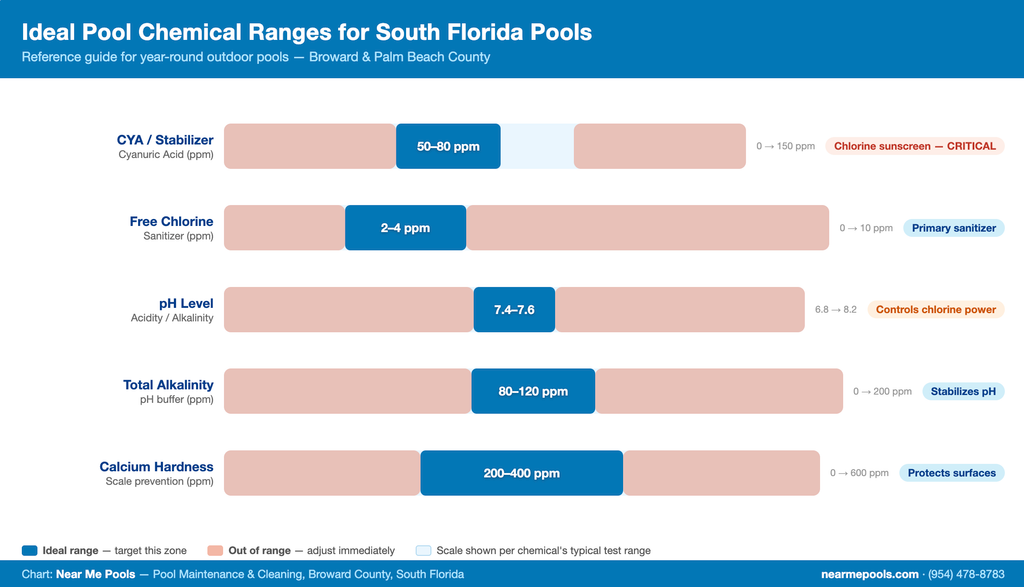
For outdoor pools in South Florida, the generally recommended CYA range is 50–80 ppm (parts per million). Some professionals push to 70–80 ppm during summer months when UV exposure is at its peak.
Here’s the catch: too much CYA is also a problem. When CYA climbs above 80–100 ppm, it starts over-stabilizing your chlorine — meaning the chlorine is still technically present in your water, but it’s locked up and can’t effectively sanitize. This is called chlorine lock, and it’s why some pool owners shock repeatedly with no results. Their chlorine test looks fine on paper, but the pool still turns green.
Pro Tip: If your CYA is above 100 ppm, the only reliable fix is a partial drain and refill to dilute the levels. No chemical will lower CYA — it has to be physically removed from the water.
Stabilized vs. Unstabilized Chlorine
Many pool owners use trichlor tablets (the standard 3-inch chlorine tabs that go in a floater or feeder). These are stabilized — they already contain CYA built in. This is convenient, but it means CYA gradually builds up in your water over time. Every tablet you add increases your CYA level slightly.
If you’re dosing heavily with trichlor tabs through a hot Florida summer and never draining any water, your CYA can creep into the 100+ ppm range by late season.
On the flip side, liquid chlorine (sodium hypochlorite) and calcium hypochlorite granules are unstabilized — they add no CYA. If your pool is stabilizer-free or low, using liquid chlorine without adding CYA separately means the sun will chew through it in hours.
Neither approach is wrong — it depends on your current CYA level, how much you’re dosing, and how often you’re testing.
Other Reasons Your Chlorine Is Disappearing
CYA is often the biggest factor, but it’s rarely the only one. Here are the other common chlorine consumers:
Organic Load: Bathers, Sunscreen, and Debris
Every person who swims brings chlorine demand with them — sweat, sunscreen, body oils, and other organics all react with chlorine and neutralize it. A pool that gets heavy use on the weekend will need significantly more chlorine Monday than one that sat quiet all week.
Leaves, grass, pollen, and rain runoff also introduce organic matter. South Florida rain events — especially during the wet season from May through October — can dump enough organic debris and dilution into your pool to seriously knock your chemistry off balance.
Algae: The Hidden Chlorine Consumer
You might not see green yet, but algae can be present in small, invisible quantities that still consume chlorine. If your pool seems to chew through chlorine faster than normal and the water has a slightly dull or hazy quality, early-stage algae could be the culprit.
This is one of the main reasons a shock treatment (separate from your regular chlorination) is important in South Florida — it kills algae before it has a chance to establish.
pH That’s Too High
This one surprises a lot of people: chlorine is far less effective at high pH levels. At a pH of 8.0, only about 3% of your chlorine is in its active sanitizing form. At the ideal pH of 7.4–7.6, that number climbs to 50–60%.
In other words, if your pH has crept up (which happens naturally in most pools), your chlorine is still technically present in the water — it’s just not doing much. From a testing standpoint, your chlorine looks fine. From a sanitation standpoint, you’re running on fumes.
South Florida water tends to run alkaline, so keeping pH in range requires consistent monitoring and adjustment.
How to Stop the Chlorine Drain: Practical Steps
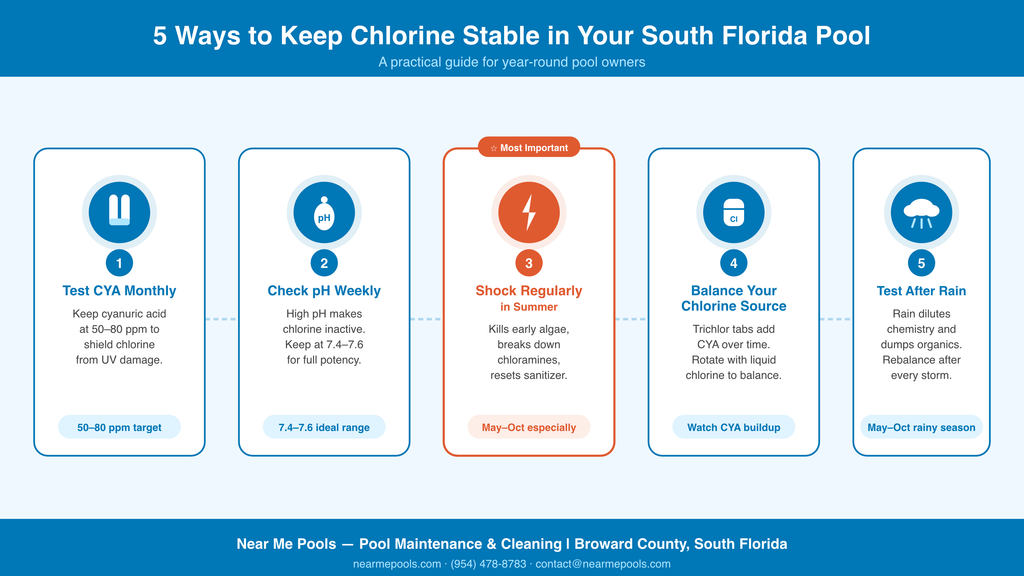
1. Test your CYA level — and test it regularly.
Most at-home test strips don’t include CYA. You’ll need a dedicated CYA test kit or liquid drop test to get an accurate reading. Aim to test monthly and adjust before the level creeps too high.
2. Keep your pH in range, every week.
pH is the most frequently ignored lever in maintaining chlorine effectiveness. A pH test takes 30 seconds. If it’s consistently above 7.6, add a pH decreaser (muriatic acid or dry acid) to bring it back down. You’ll get noticeably more mileage out of every chlorine addition.
3. Shock regularly during summer months.
Even if your chlorine levels look acceptable, a shock breaks down combined chlorine (chloramines), kills early-stage algae, and resets your sanitizer baseline. In South Florida’s summer heat, this isn’t optional — it’s part of basic maintenance.
4. Balance your chlorine sources.
If you’re running stabilized tablets, test your CYA every 4–6 weeks during heavy use. If it’s climbing above 70 ppm, consider switching to liquid chlorine temporarily to maintain levels without adding more CYA. Partial water exchanges once or twice a year also help reset accumulated CYA.
5. Test after every significant rain event.
Rain dilutes your chemistry and dumps organics and debris into the water. A 30-minute test-and-adjust session after a Florida storm prevents a weekend of chemistry problems from turning into a week-long algae recovery.
If keeping up with all of this every week feels like more than you signed up for, that’s understandable. The team at Near Me Pools handles weekly chemical testing and balancing across Broward County — including CYA monitoring, pH adjustments, and shock treatments when the pool needs it.
The Bottom Line
Chlorine loss in South Florida isn’t a product failure or a fluke — it’s physics. The UV intensity here is relentless, and without the right CYA levels protecting your chlorine, you’re fighting a losing battle no matter how much you add.
The fix comes down to three things: keep your CYA in the 50–80 ppm range, maintain your pH between 7.4 and 7.6, and shock regularly during the warm months. Get those three variables dialed in and you’ll find your chlorine going a lot further — and your pool staying clearer with far less effort.
[IMAGE PROMPT: Photorealistic 8K, wide shot of a beautiful South Florida residential backyard pool at golden hour. Crystal-clear blue water with perfect sparkle. Screened lanai, lush tropical landscaping. A pool technician in a Near Me Pools branded shirt is reviewing a digital tablet near the equipment pad after completing a service visit. Warm golden light. Aspirational, premium feel. Hyper-detailed, professional photography style.]
Alt text: Pool service technician reviewing chemical test results on tablet at a beautifully maintained South Florida pool at golden hour
If you’d rather leave the chemistry to someone who does this every day, Near Me Pools serves Broward County and parts of Palm Beach County. Reach out to our team, give us a call at (954) 478-8783, or email us at contact@nearmepools.com — we’re happy to take a look and get your pool running the way it should.
Frequently Asked Questions
Why does my pool keep losing chlorine even when I test it and add more?
The most common reason is low cyanuric acid (CYA). Without a stabilizer to protect it, chlorine in a South Florida pool can break down in just a few hours of direct sunlight. Test your CYA level — if it’s below 50 ppm, you’ll need to bring it up to protect your chlorine investment. You can learn more about maintaining water chemistry with a professional pool maintenance service.
What is CYA and how much should I have in my pool?
CYA stands for cyanuric acid, also called pool stabilizer or conditioner. It bonds to free chlorine and protects it from UV degradation. For outdoor pools in South Florida, the recommended range is 50–80 ppm. Below that, chlorine burns off too fast. Above 100 ppm, chlorine becomes ineffective even when it’s technically present in the water.
How do I lower CYA if it’s too high?
There’s no chemical that reduces CYA. The only way to bring it down is to drain a portion of your pool water and refill with fresh water to dilute the concentration. If your CYA is at 120 ppm, for example, you’d typically need to drain and replace roughly 30–40% of your pool volume to bring it back into range.
Does rain affect my pool’s chlorine levels?
Yes, significantly. Rain dilutes your water chemistry, including chlorine and CYA levels. It also introduces organic matter — pollen, dirt, leaves — that increases chlorine demand. After any significant rain in South Florida, it’s worth testing and re-balancing your water, especially during the wet season from May through October.
Why does my pool smell strongly of chlorine if there isn’t enough in it?
That strong chlorine smell is actually a sign of too little chlorine, not too much. The odor comes from chloramines — a byproduct formed when chlorine reacts with nitrogen compounds like sweat and urine. A properly chlorinated pool should smell clean, not chemical. If yours smells like a hotel pool, it likely needs a shock treatment to break down the chloramines.
How often should I test my pool water in South Florida?
At minimum, test free chlorine and pH twice a week during summer, and once a week during cooler months. Test CYA monthly. Test total alkalinity and calcium hardness monthly. If you’re seeing recurring issues, more frequent testing will help you catch the cause faster. Most professional pool services test all key parameters at every visit and send a report afterward.