

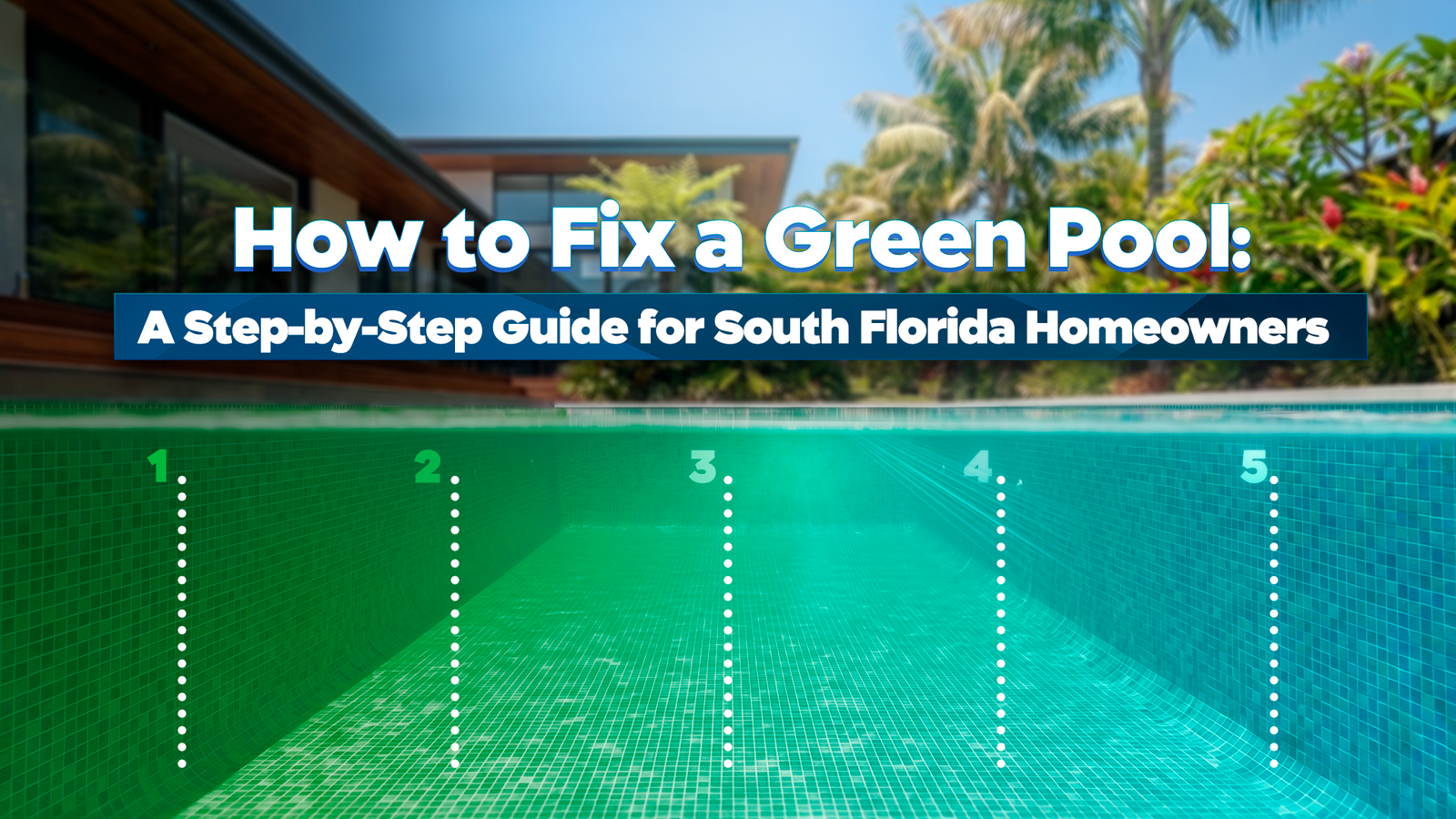
It happens fast. You went away for the long weekend, skipped a week of chemicals, or got hit with a few days of heavy summer rain — and now your pool looks less like a swimming pool and more like a swamp. The water is murky green, possibly dark enough that you can’t see the bottom, and you’re standing there wondering if you’ve crossed some point of no return.
You haven’t. A green pool is fixable, and most South Florida homeowners can get it back to clear in three to seven days with the right approach. The key word there is approach — because randomly dumping chemicals in and hoping for the best usually extends the process and costs you more money than doing it right the first time.
This guide walks you through exactly how to fix a green pool, from testing the water to the final vacuum pass, and explains why each step matters.
What Actually Turns a Pool Green?
Before you can fix it, it helps to know what you’re dealing with. That green color is algae — specifically, chlorophyll-producing microorganisms that thrive in warm, nutrient-rich water when chlorine levels drop too low to keep them in check.
Algae doesn’t just show up out of nowhere. It’s almost always present in pool water in microscopic amounts. What keeps it invisible is a well-maintained chlorine level. Once chlorine drops — whether from Florida’s intense UV rays burning it off, heavy rain diluting your chemistry, or just a missed service visit — the algae seizes the opportunity and starts multiplying fast.
In South Florida’s heat, a pool can go from clear to visibly green in 24 to 48 hours once chlorine falls below safe levels. That’s not an exaggeration — the warm water and year-round sunlight create near-ideal growing conditions for algae. It’s one of the reasons pool chemistry here requires more attention than in cooler climates.
How Bad Is It? The Green Spectrum Matters
Not all green pools are equally far gone, and the severity of the algae bloom affects how much shock you’ll need and how long recovery will take.
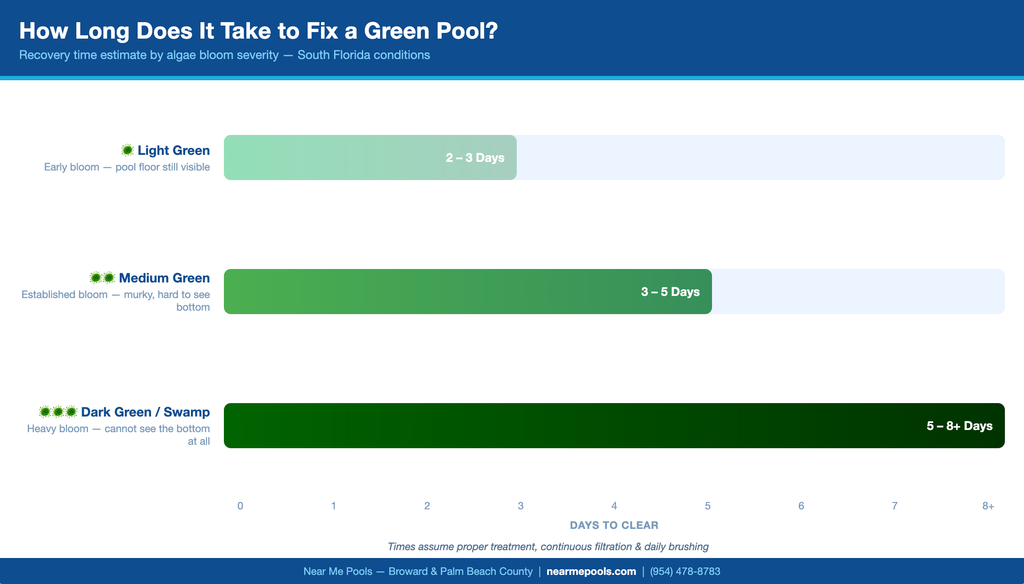
Light green or teal: Algae is present but the bloom is early. You can probably still see the pool floor, even if visibility is reduced. This is the easiest to fix — typically two to three days with a solid treatment plan.
Medium green (murky, hard to see the bottom): The bloom is more established. Expect three to five days of treatment. You’ll likely need a double or triple shock dose and consistent filtering.
Dark green, black-green, or swamp-like: The algae is heavily established and may be clinging to the walls and floor in thick mats. Recovery takes five to seven or more days, sometimes requiring multiple rounds of shocking and vacuuming. Some pools this far gone benefit from a professional deep clean or acid wash.
If your pool is dark green and you genuinely can’t see more than a foot or two into the water, that’s a good time to at least consider calling in professional help — not because it’s impossible to fix yourself, but because the process is labor-intensive and getting the chemistry right matters more at that level.
What You’ll Need Before You Start
Getting your supplies together before you begin saves you from having to stop mid-treatment. Here’s what you’ll typically need:
- A pool water test kit or test strips — don’t skip this step; you can’t fix the chemistry if you don’t know where it’s starting
- Chlorine shock — get more than you think you need; for a medium or dark green pool you’ll likely go through multiple bags
- Algaecide — use after shocking, not before or during
- Pool brush (wall brush and a separate floor vacuum head if your pool has a lot of settled debris)
- Clarifier — optional but helpful; speeds up the filtering process in the later stages
- A working filter and pump — this is non-negotiable; you cannot fix a green pool without running your filter continuously
One practical note: if your pool is visibly green, don’t bother running a test strip in that water — it won’t read accurately. Get the initial shock treatment in first, then test and adjust once the water starts to clear.
How to Fix a Green Pool: Step by Step
Step 1: Test Your Water (Or Skip to Shocking If It’s Very Green)
If your pool is light to medium green, start with a water test. What you’re looking for:
- pH: Should be between 7.2 and 7.4 for shock to work effectively. If your pH is too high (above 7.6), your shock chlorine loses a significant amount of its killing power before it even gets to the algae.
- Chlorine: Almost certainly near zero if you have a green pool.
- Alkalinity: Aim for 80–120 ppm. Low alkalinity makes pH unstable, which makes everything harder.
If your pool is dark green or swamp-like, you likely can’t get an accurate reading anyway. Go ahead and shock it first — you’ll test and fine-tune once the water starts clearing.
Step 2: Balance Your pH Before Shocking
This step is often skipped and it’s a mistake. Shock is essentially wasted if your pH is out of range.
- If pH is above 7.6, add a pH decreaser (sodium bisulfate) to bring it into the 7.2–7.4 range.
- If pH is below 7.2, add a pH increaser (sodium carbonate) to raise it.
Let the pump run for 30–60 minutes after adjusting pH before moving to the shock step.
Step 3: Shock the Pool — and Don’t Be Shy About It
This is where most homeowners underdo it. For a green pool, a single bag of shock is almost never enough. Use this as a rough guide based on pool size and severity:
- Light green: 2–3x the standard dose (standard is typically 1 lb of shock per 10,000 gallons)
- Medium green: 3–4x the standard dose
- Dark green: 4–5x or more; repeat shocking may be needed after 24 hours
Use calcium hypochlorite shock (granular) for the fastest results — it’s the most effective for breaking down heavy algae blooms. If you’re adding it to the water, do it in the evening to prevent UV from degrading it before it has a chance to work.
Always add shock by broadcasting it across the pool surface (or pre-dissolving in a bucket of water for pools with vinyl liners). Never add shock through the skimmer.
Pro tip: After shocking, if the water turns a milky blue-gray rather than staying green, that’s a good sign — the chlorine is killing the algae. If it stays bright green for more than 24 hours after shocking, your chlorine demand is higher than your dose. Add more.
Step 4: Run Your Filter Continuously
Once you’ve shocked, run your pump and filter 24 hours a day until the water clears. This is non-negotiable. The filter is what physically removes the dead algae from the water — without it running constantly, the dead cells just float back around.
- Check and clean your filter every 24 hours during the recovery process. A dirty filter reduces flow and slows everything down.
- If you have a sand or DE filter, backwash daily until the backwash runs clear.
- If you have a cartridge filter, rinse the cartridge with a hose every day. You may need to rinse it multiple times if the pool is heavily infected.
If your filter pressure is spiking dramatically (10+ psi above normal) within hours of cleaning, your algae load is very high — that’s expected. Keep cleaning and keep running.
Step 5: Brush the Pool Walls and Floor
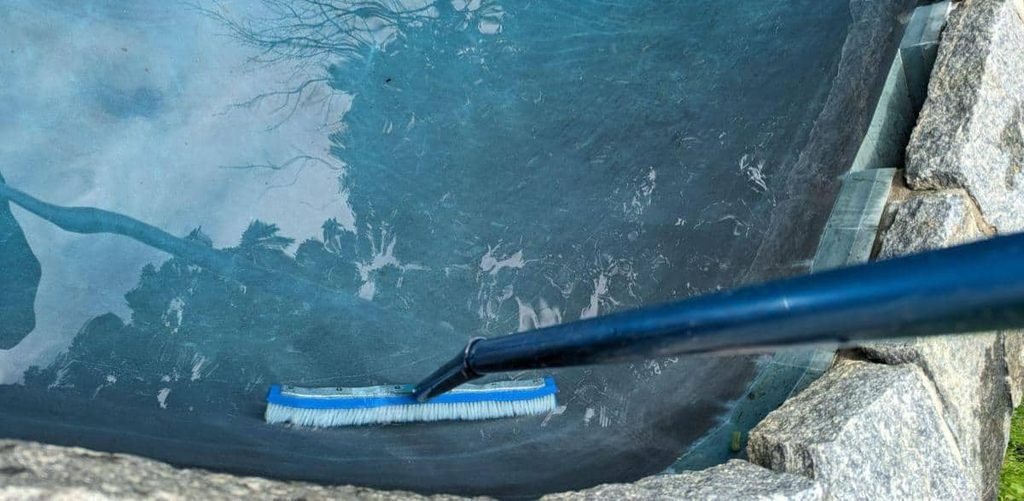
Don’t wait for the water to clear before brushing. Brush now, while the shock is fresh. The goal is to physically dislodge algae that has attached itself to the walls, floor, steps, and any crevices.
Use a stiff nylon pool brush (or a wire brush for plaster surfaces) and work systematically — walls first, then corners and steps, then the floor. Brush algae into the center of the pool so your circulation can pick it up and send it through the filter.
Brush again every 24 hours throughout the recovery process. Each brushing stirs up settled debris and keeps the algae exposed to the chlorine and the filter.
Step 6: Add Algaecide (After, Not Before)
Algaecide is not a replacement for shock — it’s a follow-up. Add it 24–48 hours after shocking, once the free chlorine level has dropped back below 5 ppm. High chlorine will degrade algaecide on contact, wasting your money.
Use a non-foaming, copper-free algaecide unless you’re dealing with yellow (mustard) or black algae, which may require more targeted formulas. Follow the label dosing instructions for your pool volume.
Algaecide helps kill any remaining algae cells the shock didn’t eliminate, and it provides a residual barrier against re-bloom while your water continues clearing.
Step 7: Vacuum and Filter Through the Final Clearing Stage
Once the water shifts from green to murky blue or cloudy gray — you’re in the home stretch. The algae is dead; you’re just clearing out the remnants.
At this stage:
- Vacuum to waste if your system allows it (especially for heavily settled pools). This bypasses the filter and removes debris directly, preventing filter overload.
- Add a clarifier to help your filter grab fine particles more efficiently. This can cut the final clearing stage by a day or two.
- Continue running the filter 24/7.
- Retest chemistry: adjust pH, chlorine, alkalinity, and CYA as needed once the water is visibly clear.
Most pools complete this final stage in 24–48 hours.
Why South Florida Pools Turn Green Faster
If you feel like your pool turns green faster than it should, you’re probably right — and it’s not your fault. A few factors specific to South Florida make algae management more challenging here:
Year-round heat. Warm water accelerates algae growth year-round. There’s no “off season” where the cold slows things down, like there is in northern states.
Intense UV. Florida’s sun breaks down unstabilized chlorine fast — sometimes within hours. If your cyanuric acid (CYA) level is too low, your chlorine is essentially unprotected. We covered this in detail in our article on why South Florida pools lose chlorine so fast.
Summer rain. Heavy rains dilute your chemicals and introduce phosphates from runoff — phosphates are essentially algae fertilizer. After a summer rainstorm, you should always test and adjust your chemistry.
Screened enclosures. While lanais reduce debris, they can also trap humidity and limit UV penetration in ways that affect water temperature and circulation patterns — which occasionally creates pockets where algae takes hold more easily.
How to Prevent a Green Pool From Coming Back
Fixing a green pool once is frustrating. Fixing it twice in a summer is expensive and avoidable. Here’s how to make it a one-time event:
Maintain chlorine consistently. The single best green-pool prevention is keeping free chlorine between 2–4 ppm at all times. Test twice a week in summer.
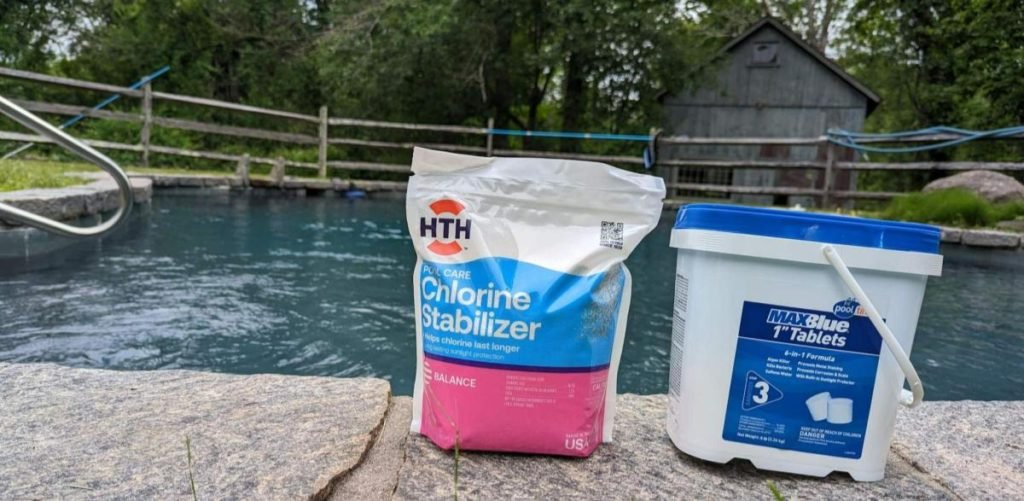
Keep your CYA in range. Cyanuric acid (stabilizer) protects chlorine from Florida’s UV. Ideal range is 30–50 ppm for a non-salt pool, 70–80 ppm for a salt pool.
Run your filter long enough. In South Florida’s heat, most residential pools need 8–12 hours of filtration per day in summer. Cutting it short means your water isn’t turning over enough to stay clear.
Brush weekly. Regular brushing prevents algae from attaching to surfaces. Takes five minutes and makes a real difference.
Don’t skip service after rain. Heavy rain events are the most common trigger for algae blooms. After a rainy stretch, add a maintenance shock dose and test your chemistry.
If you’re finding it hard to stay on top of all of this — especially through rainy season — professional pool maintenance is worth considering. A consistent weekly service keeps chemistry in range and catches early signs of algae before they become a green-pool situation.
Summary
A green pool is caused by algae bloom — almost always triggered by low chlorine, and almost always fixable at home with the right approach. The process takes three to eight days depending on severity, and the most important steps are: balancing pH before shocking, shocking heavily enough, running your filter continuously, and brushing the walls daily. Algaecide comes after the shock, not before. Don’t quit once the water turns cloudy gray — that means the algae is dead and you’re nearly there.
Get Help If You’d Rather Not Deal With It
If your pool looks like a full-on swamp, or if you’ve tried treating it and it keeps bouncing back green, it may be time to bring in a professional. Sometimes persistent green pools have underlying issues — a filter that’s not keeping up, a chemical imbalance that’s hard to pin down, or algae strains that are resistant to standard treatment.
Near Me Pools serves Broward County and parts of Palm Beach County, and we handle green pool recoveries regularly. If you’d rather hand it off, reach out to our team, call us at (954) 478-8783, or email contact@nearmepools.com — we’ll take a look and tell you exactly what it needs.
Frequently Asked Questions
How long does it take to fix a green pool?
It depends on how green it is. A light green pool (early algae bloom) can usually be cleared in two to three days with proper shocking and continuous filtration. A medium green pool typically takes three to five days. A dark green or swamp-like pool may take five to eight or more days and may require multiple rounds of shocking. The process is consistent — it just takes longer when the bloom is heavier.
Can I swim in a green pool?
You shouldn’t. A green pool has active algae growth, which also indicates low or zero sanitizer — meaning bacteria and other pathogens may be present. Don’t swim in green pool water. Wait until the water is clear, chlorine has returned to 1–4 ppm, and pH is in range (7.2–7.6) before getting back in.
How much shock does it take to clear a green pool?
More than most people think. For a light green pool, plan on two to three times the standard shock dose. For a medium or dark green pool, you may need three to five times the standard dose, applied in the evening so UV doesn’t degrade it. If the water is still green 24 hours after shocking, add another full dose.
Why is my pool still green after shocking it?
A few common reasons: pH was too high before shocking (above 7.6 significantly reduces shock’s effectiveness), the dose wasn’t high enough for the level of algae present, or the filter isn’t running enough hours to remove the dead algae cells. Check your pH, add more shock if needed, and make sure your filter is running 24/7 and being cleaned daily.
What’s the difference between algaecide and shock?
Shock (superchlorination with chlorine) kills algae by rapidly raising the chlorine level to a point where the algae cells die. Algaecide is a separate chemical that disrupts algae’s ability to grow and survive — but it works best as a follow-up treatment once the shock has done the heavy lifting. Adding algaecide at the same time as shock is wasteful; high chlorine destroys it. Add algaecide 24–48 hours after shocking, once chlorine drops below 5 ppm.
Can algae come back after I clear the pool?
Yes, if the underlying chemistry conditions that caused it aren’t addressed. Algae blooms almost always happen when chlorine drops too low. To prevent re-bloom, maintain consistent free chlorine levels (2–4 ppm), keep CYA in range to protect chlorine from Florida’s UV, and don’t skip service after heavy rain. For help staying on top of routine pool maintenance and cleaning in South Florida, Near Me Pools offers weekly service plans across Broward and Palm Beach County.